The Bureau of the Census is requesting public input through 15 November 2022 about the forthcoming 2030 census. Topics in which the the Bureau is specifically interested, how to provide your comments, and general information on the census planning process can be found here: https://www.census.gov/programs-surveys/decennial-census/decade/2030/2030-census-main.html.
Author: clairekluskens
Webinars by the Department of the Interior Library
There are several upcoming webinars sponsored by the Department of the Interior Library that should be of interest to genealogical researchers. For information, see https://www.doi.gov/library/programs/training-sessions. It is necessary to contact the DOI Library in advance of each session for access information.
A Room for the Night
Are you researching someone who owned a hotel, motel, or inn? Did you find someone enumerated in the census at one of those locations? Did your ancestor frequent a tavern at a local inn? If so, you might learn more about the structure and its history in the records of the National Register of Historic Places!
Archives Specialist John LeGloahec takes us on a brief trip through some of those records in “A Room for the Night – Hotels, Motels, and Inns Found in the Records of the National Register of Historic Places” (NRHP) at https://text-message.blogs.archives.gov/2022/07/21/a-room-for-the-night-hotels-motels-and-inns-found-in-the-records-of-the-national-register-of-historic-places/.
John’s post helps you dig into the descriptions of over 23,000 properties with the term hotel, motel, or inn in their title in the National Archives Catalog. We promise there’s no check-out time: You can stay in the NARA Catalog as long as you like!
Letters Received by the Office of Indian Affairs, 1881-1907
Need some help figuring out how to find and access correspondence in Record Group 75, Records of the Bureau of Indian Affairs? Rose Buchanan, Archivist and Subject Matters Expert for Native American Related Records, has a recent blog post on Accessing the Letters Received by the Office of Indian Affairs, 1881-1907, at https://historyhub.history.gov/community/american-indian-records/blog/2022/08/09/accessing-the-letters-received-by-the-office-of-indian-affairs-1881-1907 that will help you get started! From there, you can also easily access other blog posts by Rose as well as Cody White, NARA’s other Subject Matters Expert for Native American Related Records.
43 Million More Images Uploaded to the National Archives Catalog Since June 2021
NARA’s “Record Group Explorer” page at https://www.archives.gov/findingaid/record-group-explorer is a good place to get information on the number of digital images available in NARA’s online Catalog at https://catalog.archives.gov/ as well as the immense quantities of textual records that exist. As of July 2022, there are 179,271,436 images in the National Archives Catalog – or approximately 1.541% of 11.6 Billion textual records. (And that’s only textual records: that count does not include motion pictures, audio recordings, or data files).
Just over a year ago, in June 2021, there were 135,404,569 images in the National Archives Catalog, or about 1.175% of an estimated 11,524,683,948 textual records. That’s an increase of over 43 million digital images in a little over a year! Progress! (Back in June 2020, those numbers stood at 109,384,656 images or .95% out of an estimated 11,509,956,576 textual records).
Want to follow along and see what’s added? The “What’s New in the National Archives Catalog” page at https://www.archives.gov/research/catalog/whats-new links to record series to which digital images have been added – and may also highlight a few interesting items.
Digitization is a slow process. Records are typically one-of-a-kind items that may be fragile, bound into volumes, or otherwise unsuitable for “high speed” automatic sheet-feeding imaging systems. Records may require unfolding; removal of staples, pins, clips, and other fasteners; repair by trained records conservators; and other preparation for imaging, such as arrangement and new or improved description. Just consider the handling care required for the bundle of records shown below, which was just a small part of a small series, Records of Clerks, Wagonmasters, and Printers Employed at Various Posts, 1865-66 (National Archives Identifier 4707062), from Record Group 92, Records of the Office of the Quartermaster General.
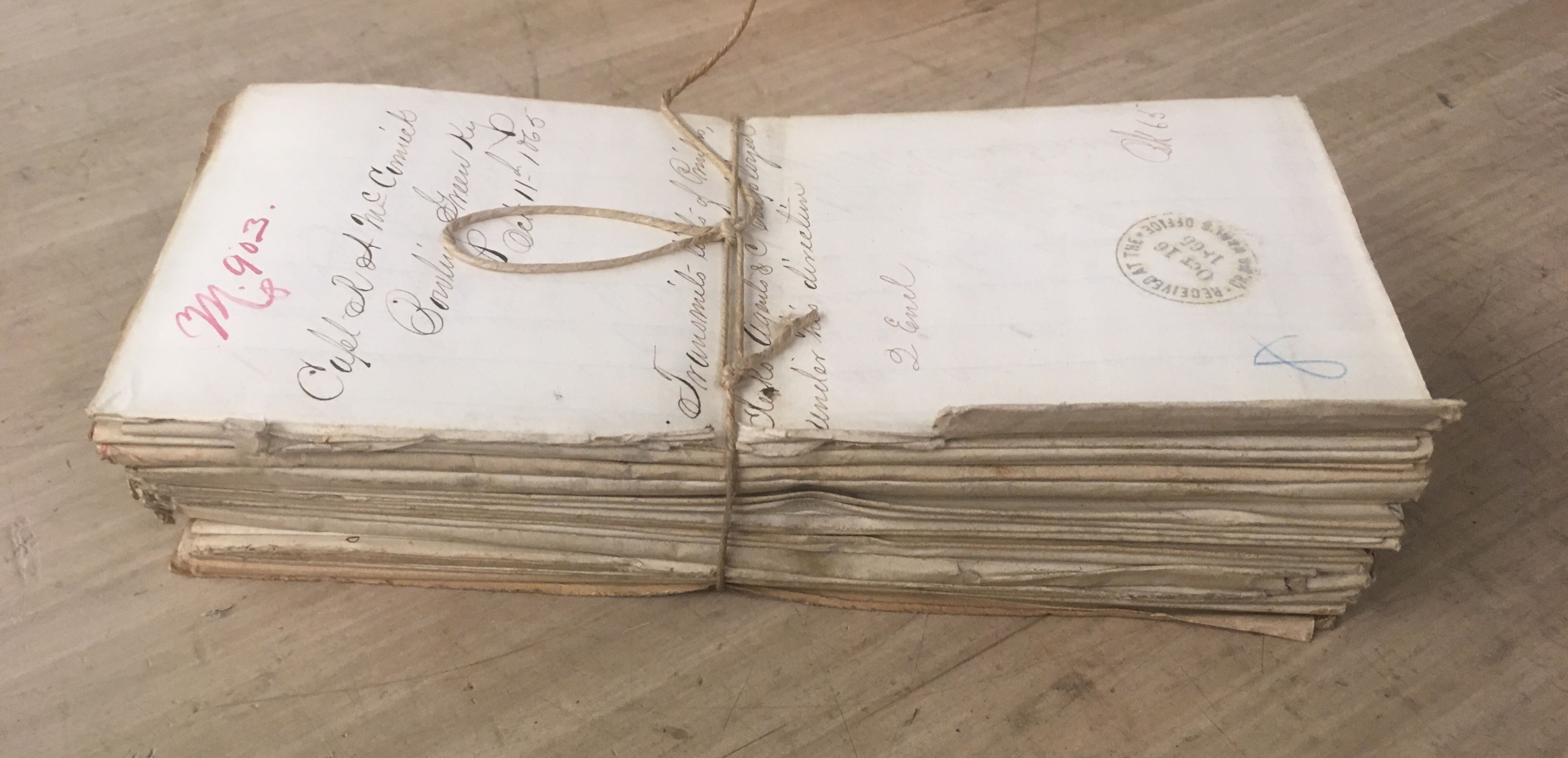
This small series is fully digitized. Each individual file unit is now is described in the National Archives Catalog by the name of the commanding officer and his geographic location, which vastly improves discoverability by researchers: see the screen shot below, which shows a few of the 389 file titles.

What records will you discover online in the National Archives Catalog?
Dr. Colleen Shogan Nominated to be the 11th Archivist of the United States
President Biden has nominated Dr. Colleen Shogan to be the 11th Archivist of the United States. Tenth Archivist David S. Ferriero retired in April 2022.
Dr. Shogan is the Senior Vice President and Director of the David Rubenstein Center for White House History at the White House Historical Association.
She previously worked for over a decade at the Library of Congress, serving as the Assistant Deputy Librarian for Collections and Services, the Deputy Director of the Congressional Research Service, and the Deputy Director of National and International Outreach. Prior to joining the Library, Dr. Shogan was a policy staffer in the Senate, handling matters on defense, appropriations, transportation, small business, and science and technology.
Dr. Shogan was the Vice Chair of the Women’s Suffrage Centennial Commission and now serves as the Chair of the Board of Directors at the Women’s Suffrage National Monument Foundation, designated by Congress to build the first Washington, D.C. memorial dedicated to the early movement for women’s equality. She is an Adjunct Professor of Government at Georgetown University, and a member of the United States Capitol Historical Society Council of Scholars.
A native of Pittsburgh, Dr. Shogan holds a B.A. in Political Science from Boston College and a Ph.D. in American Politics from Yale University, where she was a National Science Foundation Graduate Fellow. Prior to working in Congress, Dr. Shogan was an Assistant Professor of Government and Politics at George Mason University. In addition to scholarly publications, Dr. Shogan is a mystery writer and has published seven novels.
The nomination now goes to the Senate for confirmation.
Memorial Day Remembrance: Beneath His Shirt Sleeves
On this Memorial Day, as we remember the fallen heroes who sacrificed their lives to defend our freedoms and preserve one United States of America, I respectfully direct your attention to an excellent two-part article by archives specialist Jackie Budell entitled “Beneath His Shirt Sleeves: Evidence of Injury” with Part I here and Part II here. This article highlights the sacrifice and stories of eight Union Civil War veterans who lost most – or part – of an arm during their war service.
1950 Census Website Improvement: Transcribed Names are Now Shown in Search Results!
On May 17, 2022, NARA’s 1950 Census website development team made a wonderful improvement to the name search feature. Names transcribed by humans are now shown in the search results above and below the census page image. What does this mean? Let’s look at an example.
Let’s search for Mildred Lauska in Ohio. Fortunately, some human transcribed her name.
Here’s the search result showing both OCR (optical character recognition) results AND human transcription results above the census page image in the upper right under “Matched Name(s).” (Click on the image for a bigger view.)’
Mildred Lauska, ED 92-47, with search result above the census page image

Here’s the same search result showing both OCR (optical character recognition) results AND human transcription results below the census page. (Click on the image for a bigger view.)
- The OCR results generated by “Machine Learning (AI) Extracted Names” are shown first: Only Mildred’s husband, “Lauska melvins” is boldfaced because OCR had not transcribed Mildred or their daughters Joanne and Judith.
- The “User Contributed Transcriptions” are shown second: All persons with the Lauska surname shown in bold: Melvin Lauska, Mildred Lauska, Joanne Lauska, and Judith Lauska.
Mildred Lauska, ED 92-47, with search result below the census page image

Important Takeaways:
- Thank you for your transcriptions! They matter! They significantly improve the search results! In the Lauska family example, all four members of the household can easily be found instead of just one.
- Now You Can See Everyone’s Transcriptions at Work! Yay!
- Narrowing your name search to include state and county always better if the name was significantly misread by the OCR and has not been transcribed, or contains common names (John, Smith, and so forth!)
- Thank you for your suggestions for website improvements!
David S. Ferriero, 10th Archivist of the United States, Retired on April 30, 2022
David S. Ferriero, 10th Archivist of the United States, retired on April 30, 2022, after 12 years at the helm of the National Archives and Records Administration. A final interview conducted by staff member Victoria Malachi is available on YouTube. Debra Steidel Wall will serve as Acting Archivist until the next Archivist is nominated by the President and confirmed by the U.S. Senate.
1950 Census Transcriptions on NARA’s Official 1950 Census Website
Your transcriptions on NARA’s Official 1950 Census Website at https://1950census.archives.gov/ are generally indexed within 24 hours of submission. By transcribing names, you help to push those spellings – and therefore those records – to the top of search results when other users search for those names. However, your transcription will not appear in the list of “Machine Learning (AI) Extracted Names” at this time. NARA is working on an enhancement to add the transcribed names to the search results display.
 The Twelve Key