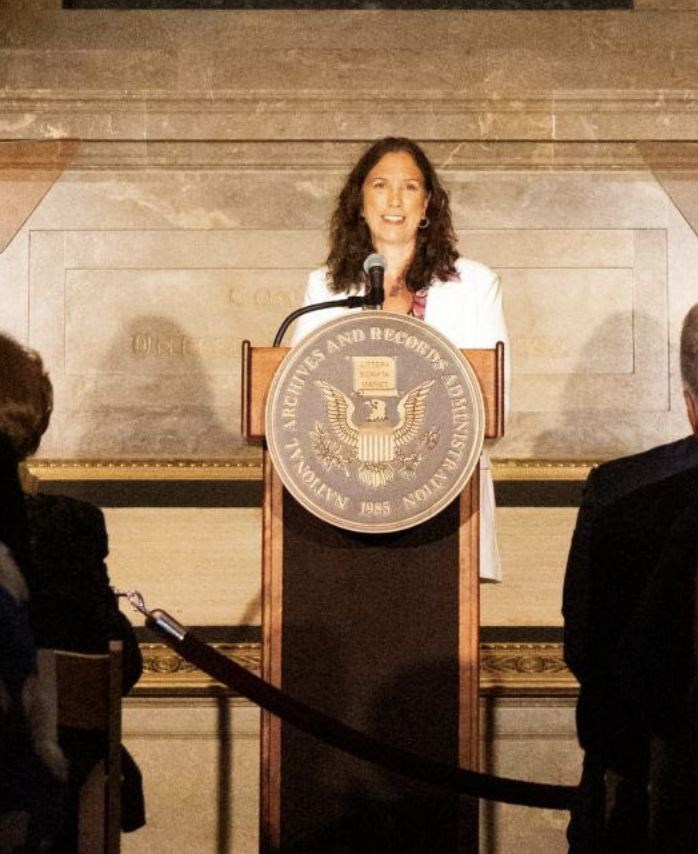
The National Archives and Records Administration (NARA) has been in the news quite a bit lately.
Support for “Save Our National Archives” – San Bruno and Chicago Regions
On 24 August 2026, Representative Kevin Mullin held a press conference about NARA’s proposed closure of its San Bruno, California, facility. In addition, 37 Members of Congress, including several from the Midwest, signed a joint letter to NARA about their concerns that closure of the facility would result in an undue burden (restriction) to public access to the records, potentially result in loss of dedicated knowledgeable public servants who have provided reference services on these records, and risk damage or even destruction to the records. Meanwhile, in an undated 2026 post entitled “Researcher Updates” NARA outlined where it plans to move records from the San Bruno and Chicago Regional Archives.
What can you do? Email (or better yet, write and call) your Congressman and Senators about your opposition to NARA closing public research facilities at San Bruno and Chicago. Find information and talking points here: https://www.saveournationalarchives.org/take-action.
Confirmation of Bradford P. Wilson as 12th Archivist of the United States
On 7 August 2026, the U.S. Senate confirmed the nomination of Bradford P. Wilson to be the 12th Archivist of the United States (AOTUS). On 21 August 2026, AOTUS Wilson sent the following message to NARA employees:
Greetings to all. As you may have heard, I was nominated by President Donald J. Trump and am now sworn in as the 12th Archivist of the United States. Though I am not a stranger to Senate-confirmed positions, I am especially honored and humbled by this appointment. As with the institutions and programs I have been fortunate to lead, I shall be laser-focused on serving the governing mission of NARA. Put simply, NARA’s mission is to serve the American people as our nation’s record keepers. The great historian, David McCullough, referred to the collected records of the National Archives as “one of the wonders of our country, the richest, most enthralling documentation we have as a nation of who we are, what we have achieved, our adventures, and what we stand for.” As such, it is imperative that those records be made available to the American people, to whom they belong. Acquisition, preservation, and organization of our nation’s records, so as to provide access to the American public, researchers, and our government, are the heart of NARA’s activities.
And your talents, experience, expertise, and commitment to your craft are the reason that Americans continue to have affection for the place of the National Archives in American government and culture. I know that our agency is beset with great challenges in achieving its goals. That should only add to our sense of common purpose and inspire us to do our very best, together, to meet those challenges.
I’ll spare you my thoughts on leadership, which I’ll daily attempt to illustrate by my actions. I’d rather begin by learning about the work you do and its relation to the statutory mission of NARA, which by law we must take as our guide. I look forward to working with you to move NARA to a new level of excellence.
Sincerely,
Bradford Wilson
It’s a reasonable sounding statement of support for preservation and access to federal records, but, as the saying goes, the proof will be in the pudding. The statutory missions of agencies are never spelled out in granular detail in Acts of Congress. See, for example, the National Archives and Records Administration Act of 1984 (Public Law 98-497). Additional guidance is given by federal laws applicable to all or most federal agencies as well as duly promulgated federal regulations, such as those for NARA, or applicable to all or most federal agencies. What is the concept for moving NARA to “a new level of excellence”?
What can you do? Pay attention to NARA press releases and social media posts from reputable sources, such as APG (https://www.facebook.com/AssociationofProfessionalGenealogists), NGS (https://www.facebook.com/ngsgenealogy), and others.
NARA Proposal to Destroy Federal Civilian Official Personnel Files after 65 Years
On 10 July 2026, NARA posted a proposed change in the retention period for federal civilian employee Official Personnel Folders (OPFs) – posted on Regulations.gov as DAA-GRS-2026-0001 General Records Schedules National Archives and Records Administration General Records Schedule 2-2 – Employee Management Records Revision) (https://www.regulations.gov/document/NARA-26-0331-0008). Unfortunately, the public comment period ended 24 August 2026.
Federal civilian Official Personnel Folders (OPFs) can contain valuable genealogical information about a person’s government employment. Today, many OPFs for employees who left federal service before 1952 are archived at NARA. Later files generally remain under OPM control and are much harder to access. The 1952 cutoff was created for administrative purposes, not because the records on either side of that date have different historical value.
In 2025, NARA proposed making OPFs for employees separated through 31 December 1973 permanent records, but this schedule has apparently not yet been approved. The National Genealogical Society and the Records Preservation and Access Coalition (RPAC) support that proposal and call on NARA to sign that record schedule. RPAC seeks to:
• Preserve pre-1974 OPFs permanently.
• Make all employment years consistent with pre-1974 policy.
• Replace the arbitrary 1952 access cutoff with a rolling transfer of older civilian personnel files to NARA.
This is simple: federal civilian personnel files should become more accessible as they age—not disappear.
What can you do? Although the public comment period is over, the fight to preserve these records will not end. Email (or better yet, write and call) your Congressman and Senators about your opposition to NARA destroying federal civilian Official Personnel Files. Tell Congress that OPFs dated after 1952 have as much historical value as earlier dated records. Tell Congress why these records are meaningful to you.