Records of Claims Against the Federal Government

The idea of looking for ancestors in records of claims against the U.S. Federal Government (or against foreign governments) would be an afterthought, at best, for most researchers. Yet, they can contain valuable data. Here’s a few examples:

French Spoliation Claims. These were claims presented by U.S. citizens against France, Spain, and Holland for vessels and cargo taken by privateers prior to September 30, 1800, and condemned at ports controlled by those countries. There are records of these claims in the National Archives of the United States. The long and convoluted general history of those claims, along with guidance on the research process, is found in Angie Spicer VanDereedt’s 1991 Prologue article, “Do We Have Any Records Relating to French Spoliation Claims?

Claims Involving Various Foreign Countries, 19th-20th centuries, in a variety of contexts. For brief introductory information, see Records of Boundary and Claims Commissions and Arbitrations.

Southern Claims Commission approved, barred, and disallowed claims. From March 1871 to March 1873, over 22,000 Southerners filed claims alleging they had been loyal Unionists during the Civil War and had furnished to, or had materials taken by, the Union Army or Navy. These are very useful to family historians because the paper trail created by the claimants and various witnesses included relatives, neighbors, friends, former slaves, and free people of color. Their testimony provides a wealth of information about individuals living in the South during the Civil War. Get started with these records by learning more about them in the guide to “Researching Southern Claims Commission Records” on the Saint Louis County (Missouri) Public Library website.

Civil War Claims against the Office of the Quartermaster General The Quartermaster General (QMG) and his staff were responsible for procuring all the equipment and supplies the Army needed. Generally, claims arise when mistakes happen of one kind or another. In 1901, a clerk in the office of the QMG compiled a list of 19 different claims boards that had been created during the Civil War which gave a brief description of the location, purpose, composition, and authority of each board. You can read through that 9 page list here.

One of those 19 boards was the Cairo Claims Commission. By direction of President Lincoln, Secretary of War Edwin M. Stanton appointed a commission to examine and report upon all unsettled claims against the War Department at Cairo, Illinois, that originated before April 1, 1862, due to allegations of fraud and corruption in the Quartermaster Department there. Stephen B. Logan, Charles A. Dana, and George S. Boutwell were first appointed, but Shelby M. Cullom soon replaced Mr. Logan, who resigned due to ill health. The commission examined 1,696 claims totaling $599,219.36, and approved and certified for payment $451,105.80. Most of the claims rejected were for losses suffered in active operations of the army, either from misconduct soldiers or from requisitions made by officers who failed to give receipts and certificates to the claimants, who thus had insufficient evidence to support their claims. Some claims were rejected due to proof of disloyalty by the claimant. Claims by owners of vacant lots and by the Cairo city trustees for use of city land were disallowed. A small percentage of the claims were rejected due to fraud. Charles A. Dana discusses the Commission in his biography, Recollections of the Civil War: With the Leaders at Washington and in the Field in the Sixties (New York and London: D. Appleton and Company, 1913), pp. 11-14.

The Proceedings of the Claims Board Meeting at Cairo, Illinois, are online. Following the meeting minutes, they include a roughly alphabetical list of claimants that gives the voucher number, date, name of claimant, name of officer who had approved the expense, type of article or claim, amount of claim proffered, and the amount allowed by the claims board.

In conclusion…. As always, finding records in the National Archives about an ancestor requires that person to have had some kind of interaction with the Federal Government. Claims against the government are one possibility, but it will take time and effort by the researcher to locate that information.

19th and Early 20th Century Federal Employees

Researching the career of a 19th or early 20th century federal employee requires delving into specialized records. Twenty-three years ago my article, “Documenting the Career of Federal Employees” was published in NARA’s Prologue magazine. The advice given then is still relevant today. There are still three basic steps in this research process. What has changed is online access to publications, finding aids, and–to some extent–records.

Step 1: Determine When, Where, and By Whom Employed. The Official Register of the United States is still the basic resource for this task. You can read more about it in John P. Deeben’s 2004 article. Fortunately, many of them are now online on Hathitrust.org. This important step enables the researcher to identify the federal agency or agencies that employed the ancestor. Knowing the agency means the researcher can then identify the appropriate Record Group(s) of interest in the National Archives and Records Administration.

Step 2: Identify Records Series that Might Provide Information. In the days before digital access, researchers had to consult inventories, preliminary inventories, and other finding aids onsite at the National Archives, or find them in a library, or obtain copies of them to peruse at home. Now, nearly every record series for every Record Group can be found in NARA’s online Catalog. Although using the Catalog can be daunting, it is accessible from home, and at your convenience.

Step 3: Examine Relevant Records. In most cases, the researcher will have to examine these records onsite at the NARA facility that holds the records. However, online access is slowly increasing through (1) enhanced description and/or (2) digital images.

  • Enhanced Description provides detailed information to allow the researcher to decide whether the records will be useful. For example, each of the 22 files in the series, Records Relating to the Protection of Mail Transport by Armed Guards, 1926-1932 indicates which postmasters and post offices (primarily larger cities) are included in the series. Here is the direct link to the Indiana file as an example. The records can then be perused onsite in the National Archives Building, or specific records can be requested by mail. If your ancestor was the postmaster or a postal employee of that post office, the records will provide insight into some of the work processes involved at that post office.


Learning more about an ancestor’s federal career will add biographical details to incorporate into their life story. You’ll get to know that person better.

National Archives Draft Strategic Plan for FY 2018-2022

The National Archives and Records Administration (NARA) announced a Draft Strategic Plan for Fiscal Years 2018-2022 in August, and has just issued its revised plan, based on public and staff comments. This is a process that every federal agency goes through every four years.

One of the goals is to digitize 500 million pages of records and make them available through our online Catalog. This is ambitious; there are about 37 million images in the Catalog currently.

The future: it will be interesting. Never a doubt about that.

Dangerous Assumptions!

We all do it. We make assumptions all the time. About everything.

In genealogy, we make assumptions about our ancestors, although their worlds were far different than ours.

We make assumptions about the records. Beginners often assume there’s “no record” of an ancestor simply because they cannot find it–for any one of a myriad of reasons. A researcher might assume that absence of one kind of record means that related records are also lost. Experienced genealogists are not immune from the assumption disease, either.

The 1820 population census schedules of New Jersey are long gone. They were lost long before there was a National Archives. But are all 1820 census records for New Jersey lost? No.

The 1820 manufacturing census schedules for New Jersey did survive, and they are published on National Archives Microfilm Publication M279, Records of the 1820 Census of Manufactures, Roll 17. There are schedules for over 300 men and firms, and it’s great stuff.

Here’s the list of New Jersey marshals, types of industries, and manufacturers found in the 1820 manufacturing schedules. The schedules are arranged by county (although not in alphabetical order), but they are also arranged in numerical order. Before microfilming, National Archives staff arranged the records geographically according to the arrangement in the published Digest of Manufactures compiled from these records in the 1820s, and then by any discernible system employed by the marshals. This arrangement permits the searcher to compare the individual schedules with the marshals’ abstracts and the Digest of Manufacturers tabulations.

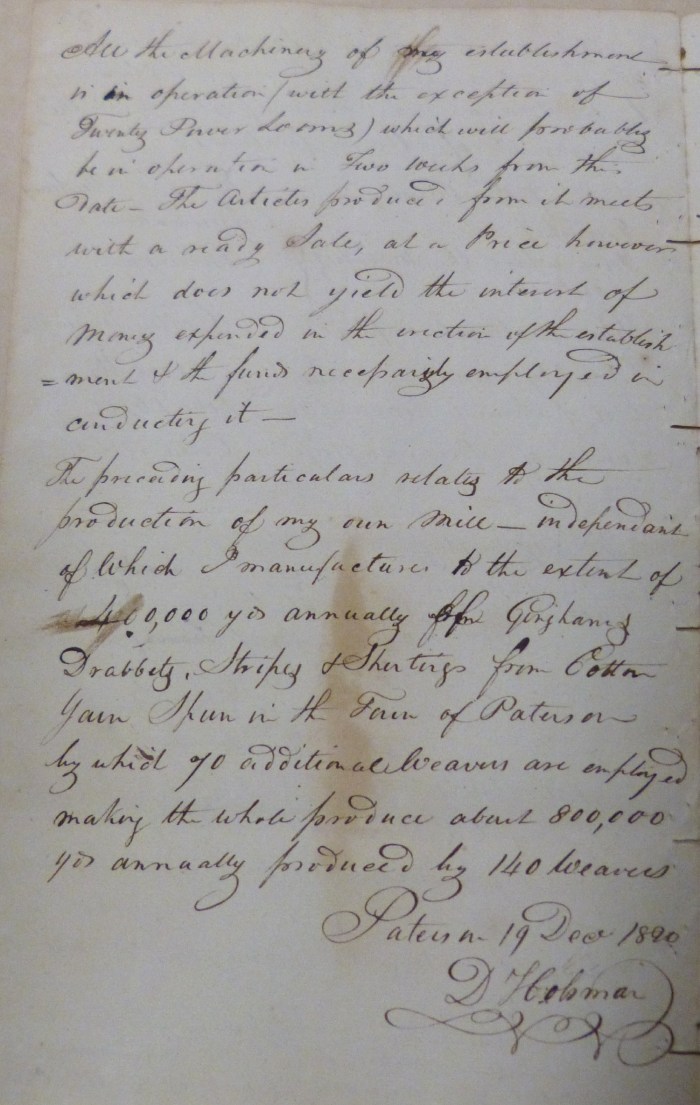
Certainly, the records show that these (presumed) heads of families lived in a particular geographic location in 1820. Better than that, however, the manufacturing census schedules document the economic underpinnings of these households and their communities. Here is the two page record for a cotton textile factory owned by D. Holsman in Paterson town, Aquacknonk township, Essex County (sorry for the blurriness in my photos). Page 1:

1820NJManufacturing23a.jpg

Page 2:

1820NJManufacturing23b.jpg

Some Assistant Marshals used pre-printed forms, as shown by this one dated at New York [City], December 1820, by J. Prall, part owner of the Rutgers Cotton Factory, also in Patterson [sic].

1820NJManufacturing.jpg

Great  stuff. Both of the factories I’ve highlighted were “large” concerns, but there were also plenty of small shops included in the manufacturing schedules. If you had ancestors in New Jersey (or any state) in 1820, take a look at M279. You’ll be glad you did.

M279 Roll List:
1 – Maine and New Hampshire
2 – Massachusetts and Rhode Island
3 – Vermont
4 – Connecticut
5 -New York
6 – New York
7 – New York
8 – New York
9 – New York
10 – New York
11 – New York
12 – Pennsylvania
13 – Pennsylvania
14 – Pennsylvania
15 – Pennsylvania
16 – Maryland
17 – New Jersey, Delaware, and District of Columbia
18 – Virginia
19 – North Carolina, South Carolina, and Georgia
20 – Kentucky and Indiana
21 – Ohio
22 – Ohio
23 – Ohio
24 – Ohio
25 – Ohio
26 – Eastern District of Tennessee
27 – Western District of Tennessee, Illinois, and pages from the published Digest of Manufactures for Alabama, Louisiana, Missouri, Michigan, and Arkansas

I have not found M279 online. Viewing copies are available at the National Archives Building, Washington, DC, and at National Archives Regional Archives in Atlanta, Boston, Kansas City (Missouri), Philadelphia, and Riverside (California). It can also be found at libraries with large genealogical collections.

Here is an easily accessible copy of the descriptive pamphlet (DP) for M279, which also describes and identifies where manufacturing data embedded within the 1810 population census can be found.

Women in the Civil War

lc-b811-2405b-laundress01663utrimmed

When we think of the Civil War, the image that likely immediately springs to mind is that of thousands of men in uniform clashing in epic battles, such as at Gettysburg.

Forgotten are the thousands of women who performed tedious, dirty, inglorious tasks–hospital matrons, hospital nurses, laundresses, cooks, and others. They were there, too, on both sides of the conflict.

Documenting their presence, identity, and contributions, is infuriatingly difficult, however, due to the paucity of records that were kept–or retained. A new article,
“Union Army Laundresses,” NGS Magazine, Vol. 42, No. 3 (July-Sept. 2016): 33-37, breaks new ground by outlining research strategies for documenting the service of hospital laundresses, fort and post laundresses, and camp laundresses.

Most of these women likely came from the poorer end of the economic spectrum. They included African-Americans as well as Caucasians. Their efforts deserved to be better remembered, and I hope this article will encourage research.

95%: Describing the National Archives’ Holdings

From the blog of David Ferriero, Archivist of the United States (AOTUS).

usnationalarchives's avatarAOTUS

The National Archives Catalog has reached a milestone: we now have 95% of our holdings completely described at the series level in our online catalog. This is a monumental achievement. Why? Because the National Archives holds over 13 billion pages of records, and we are adding hundreds of millions of pages to that total every year.

Describing our records in the online Catalog means that the information for all of those holdings is in one central place for researchers anywhere to search and browse, and is vital to our strategic goal to Make Access Happen. Description enables us to provide the archival context of records as they are shared and re-used by researchers, citizen developers, and the public.

We’ve come a long way since our first online catalog was released in 2001. By 2003, only 19% of our holdings were described online for the public to view. This means…

View original post 443 more words

Civil War Chaplains

My colleague, John P. Deeben, recently published an excellent article on records in the National Archives about Union and Confederate Civil War chaplains. It is “Faith on the Firing Line: Army Chaplains in the Civil War,” Prologue: Quarterly of the National Archives and Records Administration, Vol. 48, No. 1 (Spring 2016).  Researchers will find it informative and useful.chaplains-cooke-l

1950 Census Enumeration District Maps Are Going Online

There’s still 5.7 years to go until the release of the 1950 Census on 1 April 2022, but the National Archives and Records Administration has been working for some time to get ready for that event.

Enumeration District maps involve no privacy restrictions so they can be made available to the public at any time. In “Snapshot USA: 1950 Census Enumeration District Maps,” staff member Ellen Mulligan describes the maps and the behind-the-scenes work needed to get them online.

Those “Boring” Administrative Files….

Most novice genealogists understandably focus on finding vital records of birth, marriage, and death. More experienced researchers know that understanding an ancestor’s full life – as well as finding ways around “brick wall” problems – comes from delving into a wide range of records created by government record keepers at all levels of our federalist structure.

The “wide range of records” includes those “boring” administrative files, which, it often turns out, are not so boring after all. My recent article – “Special Examiners: Records of the Bureau of Pensions’ Efforts to Combat Waste, Fraud, and Abuse, 1862–1933” – in Volume 8 of the Federal History Journal seeks to bring greater appreciation to less-well known records in Record Group 15, Records of the Department of Veterans Affairs.

The Weather Bureau and Genealogy

As the National Capital region continues to dig out from two feet (or thereabouts) of snow, it’s a good time to reflect on the genealogical uses of Record Group 27, Records of the Weather Bureau.

Our farm family ancestors kept close watch of the weather and it certainly affected their economic well-being much more than it does us city dwellers. Today, only 2% of the U.S. population are farm families; in 1790, they comprised at least 90%.

While the Weather Bureau was not established until 1890, the federal government’s interest in collecting weather information dates back to the 1810s, when army hospital, post, and regimental surgeons were directed to keep diaries of the weather. These duties were transferred in 1870 to officers reporting to the Chief Signal Officer. Meanwhile, from 1847 to 1870, the Smithsonian Institution also collected data from voluntary observers throughout the country. All of these observations are available on National Archives Microfilm Publication T907, Climatological Records of the Weather Bureau, 1819-1892 (562 rolls), which is not online.

This can be useful background information that puts flesh on the bones of those ancestors. What was the weather like on the day your ancestor was born? Married? Died? Or at some other point his or her life? You may not find an answer for your precise location, but a nearby one might be close enough. One of my grandfathers was born in November 1888, but his birth was not recorded until the spring of 1889. One suspects weather had something to do with it – even though the winter of 1888-89 was not as epic as that of January-March 1888.

My retired colleagues, Constance Potter and Kenneth Heger, used to jointly give a lecture called “Stormy Weather” that was all about the genealogical uses of weather information from federal records. Connie presents some of that information in De Smet, Dakota Territory, Little Town in the National Archives, Part 2.

The year 1816 was known as “1800 and Froze to Death” (as well as “The Year without any Summer” and other appellations). It was a year when there was frost or snow in nearly every month, and farmers planted crops two and three times only to see them die. Many farm families from the northern United States moved west in 1817 in hopes of a better future.

In 2005, Hurricane Katrina displaced thousands from New Orleans, Louisiana, with many never to return.

Weather matters.

In addition to T907, other useful federal records include:

Nonfederal sources of information include articles in newspapers in the area where your ancestors lived. For example, the Columbus, Ohio, Statesman of 15 February 1842 reprinted a news item from the Cleveland Herald that described a “Terrible Tornado” in Mayfield, Cuyahoga County, Ohio, and Kirtland, Lake County, Ohio, that caused considerable damage. More than 30 people are mentioned, along with their losses (“house unroofed,” “barn unroofed,” “barn demolished,” etc.).

Image: Flooding from Hurricane Katrina, 13 September 2005. NAID 7961819, from Record Group 48, Records of the Office of the Secretary of the Interior.