Slides – https://www.archives.gov/files/calendar/genealogy-series/2024-05-21-presentation-kluskens.pdf
Handout – https://www.archives.gov/files/calendar/genealogy-series/2024-05-21-handout-kluskens.pdf
NARA’s annual Genealogy Series features staff experts speaking about records in National Archives custody. The 2024 series begins on May 21. This year’s line up includes:
Don’t worry about missing the program! After their premiere, these videos will remain online on YouTube for future viewing.
The National Archives and Records Administration (NARA) recently digitized an 1863 census of Black persons in Princess Anne County, Virginia, that was compiled by the Union Army. Taken seven years before the 1870 census, which is normally the earliest census upon which formerly enslaved persons were listed by name, this unique record provides a valuable early snapshot of the names, ages, employment, and other information about bond (enslaved), free, or contraband individuals and families. Read more about it at https://historyhub.history.gov/african-american-records/b/african-american-records-blog/posts/census-of-black-persons-in-princess-anne-county-virginia-1863 and view the records online at https://catalog.archives.gov/id/352794518.
NARA has reintroduced a user-friendly “What’s New in the National Archives Catalog” page at https://www.archives.gov/research/catalog/whats-new. This webpage may highlight visually interesting items along with a list of:
The list shows the part of the NARA that holds the records and gives a direct link to where the records are in the Catalog. As should be expected, digital images of very large record series will usually be uploaded in increments over time (months or years), as digitization is accomplished. Digital images of very small series are normally uploaded all at once, such as the single volume series, List of Special Agents Who Collected Cotton Statistics, 1900 (National Archives Identifier 3318884).
What will you find that’s new and interesting to you?
Censuses “in-between” federal census years are always a bonus! Changes in families and neighborhoods can be more closely tracked. Missed or miss-enumerated families might be located.
NARA recently completed the digitization of a small series of off-year censuses called “Schedules of Municipal Population Enumerations, 1932-1938” (National Archives Identifier 2791185) that includes towns in Alabama, Illinois, Indiana, Missouri, North Carolina, and Pennsylvania. These are the only municipal censuses conducted by the Census Bureau that are in NARA custody.
Read more details in the History Hub blog post, “Special Censuses of 15 U.S. Towns, 1932-1938.”
The National Archives and Records Administration (NARA) recently completed digitization of the Alien Enemy Index, 1917–1919 (National Archives Identifier [NAID] 602456), that contains 57,722 index cards that document U.S. government interest in – and actions concerning – enemy aliens during the First World War. Enemy aliens were citizens of the German Empire, Austria-Hungary, Bulgaria, and the Ottoman Empire. You can read more about this index and the related records at “The Alien Enemy Index, 1917-1919, is Now Digitized!” at https://historyhub.history.gov/genealogy/b/genealogy-blog/posts/the-alien-enemy-index-1917-1919-is-now-digitized.
The map below, courtesy of Australia’s Digital Classroom, shows the European boundaries of the Central Powers whose citizens were considered enemy aliens.
Search Tips: When searching the Enemy Alien Index in NARA’s Catalog, keep in mind that the first name of some aliens are abbreviated, such as “Chas.” for Charles or “Robt.” for Robert. Therefore, if searching by first and last name yields no results, search by surname only, or even by first name only for unusual first names. Also consider searching by alternate spellings of a surname if you get no results. In addition, some women are listed by their husband’s name, such as Mrs. Theodore Zeigler (NAID 296756836). You can also browse through an entire file unit (there are 23 file units), but be sure to set the “Sort by” order to either “Title (Alphabetically, A-Z)” or “Title (Alphabetically, Z-A)” instead of “Most Relevant.”

Map URL: https://digital-classroom.nma.gov.au/images/map-showing-first-world-war-alliances
The release of the 1960 census is just 9.5 years away and the National Archives has begun a 1960 census blog post series with the first post, “1960 Census: NARA’s Already Working Toward 2032” at https://historyhub.history.gov/community/genealogy/census-records/blog/2022/10/14/1960-census-nara-s-already-working-toward-2032.
There are several upcoming webinars sponsored by the Department of the Interior Library that should be of interest to genealogical researchers. For information, see https://www.doi.gov/library/programs/training-sessions. It is necessary to contact the DOI Library in advance of each session for access information.
Are you researching someone who owned a hotel, motel, or inn? Did you find someone enumerated in the census at one of those locations? Did your ancestor frequent a tavern at a local inn? If so, you might learn more about the structure and its history in the records of the National Register of Historic Places!
Archives Specialist John LeGloahec takes us on a brief trip through some of those records in “A Room for the Night – Hotels, Motels, and Inns Found in the Records of the National Register of Historic Places” (NRHP) at https://text-message.blogs.archives.gov/2022/07/21/a-room-for-the-night-hotels-motels-and-inns-found-in-the-records-of-the-national-register-of-historic-places/.
John’s post helps you dig into the descriptions of over 23,000 properties with the term hotel, motel, or inn in their title in the National Archives Catalog. We promise there’s no check-out time: You can stay in the NARA Catalog as long as you like!
NARA’s “Record Group Explorer” page at https://www.archives.gov/findingaid/record-group-explorer is a good place to get information on the number of digital images available in NARA’s online Catalog at https://catalog.archives.gov/ as well as the immense quantities of textual records that exist. As of July 2022, there are 179,271,436 images in the National Archives Catalog – or approximately 1.541% of 11.6 Billion textual records. (And that’s only textual records: that count does not include motion pictures, audio recordings, or data files).
Just over a year ago, in June 2021, there were 135,404,569 images in the National Archives Catalog, or about 1.175% of an estimated 11,524,683,948 textual records. That’s an increase of over 43 million digital images in a little over a year! Progress! (Back in June 2020, those numbers stood at 109,384,656 images or .95% out of an estimated 11,509,956,576 textual records).
Want to follow along and see what’s added? The “What’s New in the National Archives Catalog” page at https://www.archives.gov/research/catalog/whats-new links to record series to which digital images have been added – and may also highlight a few interesting items.
Digitization is a slow process. Records are typically one-of-a-kind items that may be fragile, bound into volumes, or otherwise unsuitable for “high speed” automatic sheet-feeding imaging systems. Records may require unfolding; removal of staples, pins, clips, and other fasteners; repair by trained records conservators; and other preparation for imaging, such as arrangement and new or improved description. Just consider the handling care required for the bundle of records shown below, which was just a small part of a small series, Records of Clerks, Wagonmasters, and Printers Employed at Various Posts, 1865-66 (National Archives Identifier 4707062), from Record Group 92, Records of the Office of the Quartermaster General.
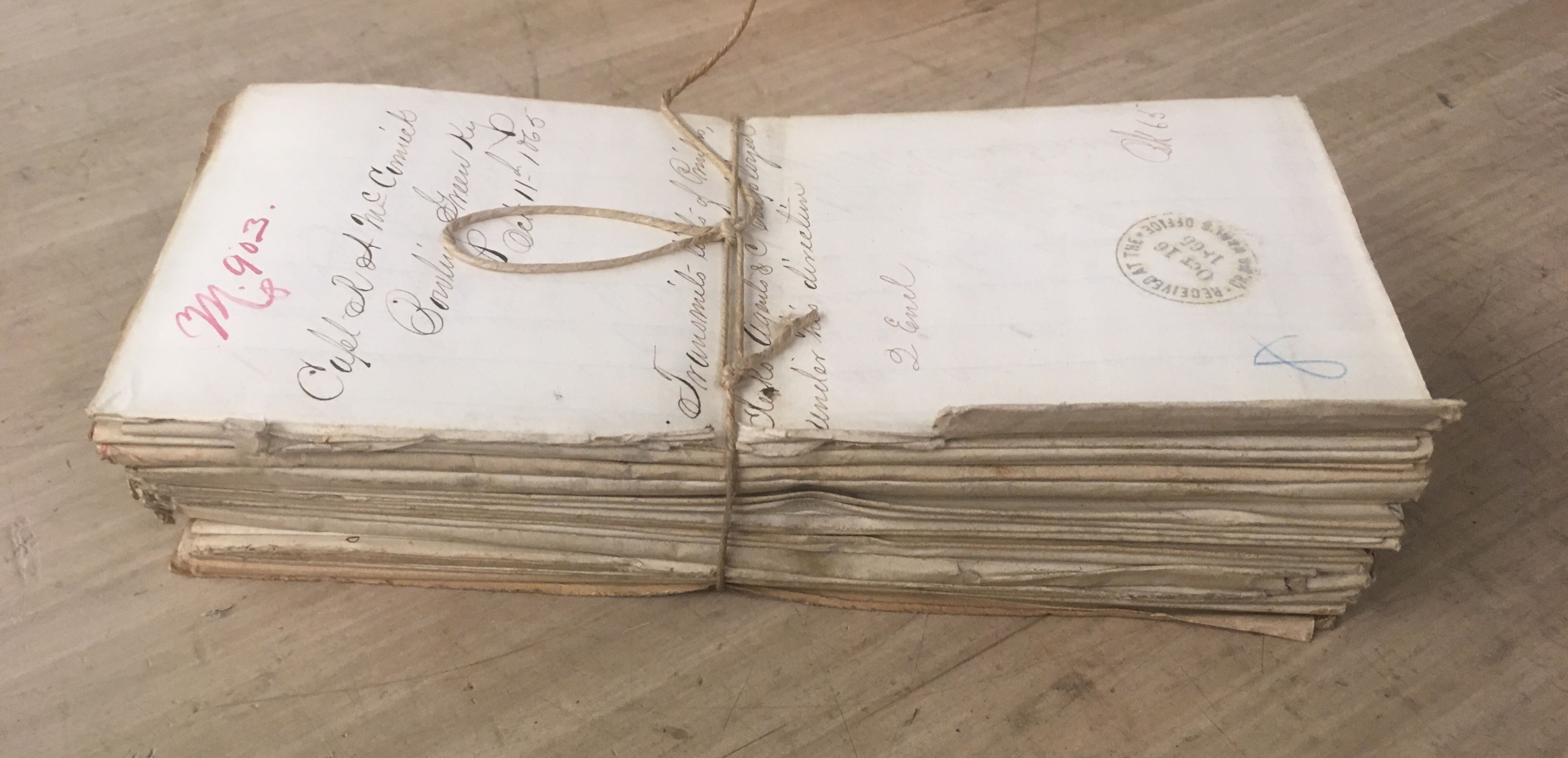
This small series is fully digitized. Each individual file unit is now is described in the National Archives Catalog by the name of the commanding officer and his geographic location, which vastly improves discoverability by researchers: see the screen shot below, which shows a few of the 389 file titles.

What records will you discover online in the National Archives Catalog?
 The Twelve Key