Presentation Slides: https://www.archives.gov/files/calendar/genealogy-series/2024-06-04-presentation-salyer.pdf
Presentation Handout: https://www.archives.gov/files/calendar/genealogy-series/2024-06-04-handout-salyer.pdf
NARA’s annual Genealogy Series features staff experts speaking about records in National Archives custody. The 2024 series begins on May 21. This year’s line up includes:
Don’t worry about missing the program! After their premiere, these videos will remain online on YouTube for future viewing.
The National Archives and Records Administration (NARA) recently digitized an 1863 census of Black persons in Princess Anne County, Virginia, that was compiled by the Union Army. Taken seven years before the 1870 census, which is normally the earliest census upon which formerly enslaved persons were listed by name, this unique record provides a valuable early snapshot of the names, ages, employment, and other information about bond (enslaved), free, or contraband individuals and families. Read more about it at https://historyhub.history.gov/african-american-records/b/african-american-records-blog/posts/census-of-black-persons-in-princess-anne-county-virginia-1863 and view the records online at https://catalog.archives.gov/id/352794518.
NARA has reintroduced a user-friendly “What’s New in the National Archives Catalog” page at https://www.archives.gov/research/catalog/whats-new. This webpage may highlight visually interesting items along with a list of:
The list shows the part of the NARA that holds the records and gives a direct link to where the records are in the Catalog. As should be expected, digital images of very large record series will usually be uploaded in increments over time (months or years), as digitization is accomplished. Digital images of very small series are normally uploaded all at once, such as the single volume series, List of Special Agents Who Collected Cotton Statistics, 1900 (National Archives Identifier 3318884).
What will you find that’s new and interesting to you?
Censuses “in-between” federal census years are always a bonus! Changes in families and neighborhoods can be more closely tracked. Missed or miss-enumerated families might be located.
NARA recently completed the digitization of a small series of off-year censuses called “Schedules of Municipal Population Enumerations, 1932-1938” (National Archives Identifier 2791185) that includes towns in Alabama, Illinois, Indiana, Missouri, North Carolina, and Pennsylvania. These are the only municipal censuses conducted by the Census Bureau that are in NARA custody.
Read more details in the History Hub blog post, “Special Censuses of 15 U.S. Towns, 1932-1938.”
Titles given to archival record series (specific bodies of records that serve a particular function) usually have dull but clear names like
Record series titles normally don’t refer to the location in which the records had been stored. For example, one would not expect records to be titled “Records from the 15th Filing Cabinet” since that would not meaningfully describe their informational content. Recently, however, I discovered that there is at least one record series named after their former storage place. It is “Materials from the Speaker of the House Joseph Cannon’s Trunk, 1903-1909” (National Archives Identifier 5987062) which is part of Record Group 233, Records of the U.S. House of Representatives.

Speaker Cannon was a powerful Speaker of the House and anyone doing research on Congress in the early 20th century should know who he was. And yes, you can see what his trunk looks like at “Trunk Used by Speaker Joseph Cannon” (National Archives Identifier 25465646).

On Monday, September 11, 2023, the National Archives and National Archives Foundation held a swearing-in ceremony for the 11th Archivist of the United States (AOTUS), Dr. Colleen Shogan. The ceremony was presided over by Chief Justice John G. Roberts, Jr., and First Lady Dr. Jill Biden gave keynote remarks.
First Lady Jill Biden spoke about the vast holdings of the National Archives and how they reflect us as a nation—“imperfectly marching toward a more perfect union.” As an educator, Dr. Biden also invoked the unofficial motto of the National Archives, what’s past is prologue, to affirm the importance of the institution’s role in learning our shared history.
Dr. Shogan took her oath, administered by Chief Justice John G. Roberts, Jr., In an acknowledgment of the historic moment, she took the podium dressed in a white pantsuit, an homage to the suffragists who blazed the path for her and other women to not only participate in government, but also to lead it.
The archivist’s remarks laid out a bold future for the agency tasked with protecting and sharing our past. Prioritizing accountability, adopting new technology, and embracing creative outreach strategies were the main points of Dr. Shogan’s vision for the agency.
View the full remarks of Dr. Shogan here: https://www.archives.gov/about/speeches/shogan/swearing-in-ceremony
View the full remarks of Dr. Biden here: https://www.whitehouse.gov/briefing-room/speeches-remarks/2023/09/11/remarks-as-prepared-for-delivery-by-first-lady-jill-biden-at-the-swearing-in-ceremony-for-the-national-archivist/
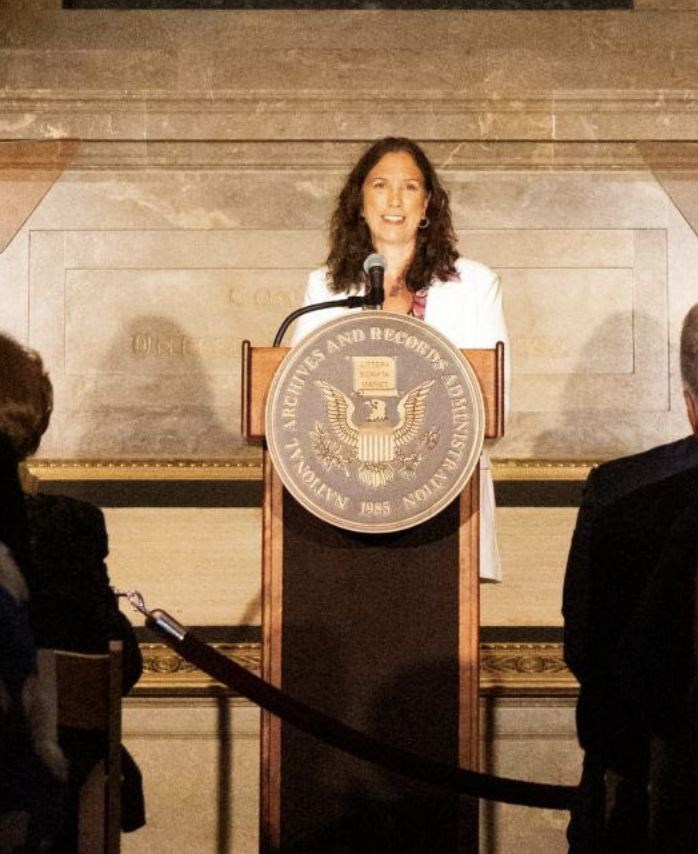
Text and photo courtesy National Archives Foundation, https://www.archivesfoundation.org/shogan-swearing-in/?goal=0_c756ed33da-436145da69-55221835&mc_cid=436145da69&mc_eid=60901072c3
You are invited! Join National Archives Foundation Executive Director Patrick Madden for a fireside chat with the new Archivist of the United States, Dr. Colleen Shogan. Viewers will learn more about her background and her vision for the National Archives. The discussion will be followed by an audience Q&A. The event is online, free, and scheduled for Monday, July 24, 2023, at 5:00 p.m. Eastern Daylight Time. Register and submit your questions for Dr. Shogan at https://www.archivesfoundation.org/event/meet-the-archivist-an-interview-with-national-archives-foundation-executive-director-patrick-madden-and-archivist-of-the-united-states-dr-colleen-shogan/

