Infinite Diversity (Part I)

One of the most interesting things about records in the U.S. National Archives is almost infinite diversity of materials that can be found. This post will highlight several small record series that have been digitized.

Record Group 15, Records of the Department of Veterans Affairs, is well known for genealogical gems like military service and pension files, but it also contains a variety of other records:

  • Bibliography of Publications Concerning Inmates in Soldiers’ Homes, ca. 1913–ca. 1927, https://catalog.archives.gov/id/407305556.
  • Records Relating to the Delaney House, 1914, https://catalog.archives.gov/id/407302072. This was a building in Washington, DC, that was used as a hospital during the Civil War. 
  • Records Concerning Confederate Homes, 1919-1927, https://catalog.archives.gov/id/407302073, includes a list of Confederate homes existing at that time. 
  • Summary Lists of Certificate Numbers Assigned to Pensioned Veterans, Navy Widows, and Army and Navy Widows, 1816–1924,  https://catalog.archives.gov/id/400216432. This series contains typescript lists that identify the dates upon which certain pension certificate numbers were assigned to pensioned veterans (“invalids”), 1816-1924; Navy widows, 1862-1910; and to widows, 1862-1924. The “widows” list includes certificate numbers issued to Army widows for 1862-August 1910 and both Army and Navy widows for August 1910-June 1924. These lists likely served as a quick reference aid to the approximate date when a certificate was issued. For example, if one wanted to know when Widow’s Certificate (WC) 190,000 was issued, the widow’s certificate list indicates it was issued sometime between June 3, 1880, when 188,500 was issued, and June 3, 1881, when 192,500 was issued.

Record Group 64, Records of the National Archives and Records Administration (NARA) includes many NARA microfilm publications because they are NARA work product.

  • NARA Microfilm Publication M2156, Lists of Federal Prisoners of War Who Enlisted in the Confederate Army (1 roll, published 2012), https://catalog.archives.gov/id/470650567, was uploaded to the Catalog in RG 64 as National Archives work product but the images of records it contains are from Record Group 249, Records of the Commissary General of Prisoners.

Record Group 92, Office of the Quartermaster General

  • Annual Reports Relating to the Army Transport Service, 1901,  https://catalog.archives.gov/id/2662956. relates to quartermaster activities that supported the U.S. Army during the Philippine-American War.

Record Group 393, Records of U.S. Army Continental Commands

  • Census of Black Persons in Princess Anne County, Virginia, 1863, https://catalog.archives.gov/id/352794518, is a unique volume in NARA holdings. In this volume, H. H. Huff of Ovid, Seneca County, New York, recorded a census of black persons who resided in Princess Anne County, Virginia. Mr. Huff began taking the census on June 23, 1863, according to a paper glued to the inside front cover of the volume. The printed census form, which spans two facing pages, asked for each person’s name and the following information:
    • Sex – Male or female
    • Age – Under 10, 10 to 20, 20 to 45, or over 45
    • Condition – Bond (enslaved), free, or contraband
    • Residence – Permanent, transient, or how long within the lines
    • How Employed – On deserted farms, otherwise employed by the government, or not employed
    • Helped by the Government – Wholly or in Part
    • Color – Black or mixed Able to read [hash mark if yes]
    • Remarks – The “Remarks” column often indicates federal employment, either in general terms, such as “on entrenchment,” or specifically, such as “Ordnance Department.”
  • List of Prisoners at Fort Jefferson (Florida) on March 31, 1866,  https://catalog.archives.gov/id/404788116, includes Dr. Samuel Mudd and other persons who assisted John Wilkes Booth after the assassination of Lincoln, as well as other military prisoners.
  • Lists of Supplies on Hand, July 1847–October 1850 (at Fort Jefferson, Florida), https://catalog.archives.gov/id/404788104, could be of interest to military historians.

Record Group  395, Records of U.S. Army Overseas Operations and Commands, contains a lot of material relating to activities of both Filipino and U.S. personnel during the Philippine-American War, 1899-1902. These are just a few examples.

  • Card List of Batson’s Scouts, July 1901, https://catalog.archives.gov/id/467258916.
  • Register of a Census Taken in the Province of Tayabas, Philippines, June 1900–September 1900, https://catalog.archives.gov/id/400216440. Each entry includes the man’s name, age, marital status, bario of residence in Tayabas, occupation (“profession”), and the census certificate number and date of issuance. All the men were indicated to be natives of Luzon. No women are included.
  • Register of Native Prisoners Confined, October 1900-May 1902, https://catalog.archives.gov/id/404788077, primarily contains a list of native (Filipino) prisoners of war confined at Balayan, Batangas, Philippine Islands. The men were captured from October 1900 to July 1901 and released by May 1902. The information was recorded across two facing pages and usually includes including each man’s name, age, residence, date of capture and by which officer, cause for which held, and “disposition” that is usually the date of release from confinement.
  • Special Orders, May-September 1900, https://catalog.archives.gov/id/404788009, were issued by commanding officers of 4th U.S. Infantry from the “Headquarters, U.S. Troops” at Bacoor, Cavite, Philippines, and primarily concern special assignments of duty to specific military personnel.
  • Special Orders, May-July 1901https://catalog.archives.gov/id/404788041, were issued from the headquarters of the 1st Squadron, 4th U.S. Cavalry, at Badoc, Ilocos Norte, Philippines, and primarily concern special assignments of duty to specific military personnel.
Mythbusting the Legend of the Baker Twins

Through compelling and thorough research, Donna Vojvodich, Historian for the U.S. Coast Guard’s SPARS Stories History Program, busts a fun but sadly persistent erroneous legend of the alleged service of the Baker twins during World War I. They were not the “first” women to serve in the Coast Guard. In fact, the Baker twins didn’t serve at all.

The honor of first goes to Myrtle Hazard, who held the rating of electrician first class (E1) and enlisted in January 1918.

You can read all about it in “The Long Blue Line: The Baker Twins—Re-searching the first female Coasties – or were they?” online at https://www.mycg.uscg.mil/News/Article/3311017/.

This is yet another example of our need, as serious family historians, to not accept other people’s unsupported conclusions as fact. We must instead carefully examine both textual and photographic records, do careful analysis, and base our conclusions on facts, not wishful thinking.

NARA’s Genealogy Series – May 21-June 25, 2024

NARA’s annual Genealogy Series features staff experts speaking about records in National Archives custody. The 2024 series begins on May 21. This year’s line up includes:

  • Passport Records: Passport Applications at NARA, 1790s-1925 – May 21, 1 p.m. ET
  • After Their Service: Tracing the Lives of Native American Army Scouts – May 28, 1 p.m. ET
  • Captured German Records Related to American Prisoners of War During World War II – June 4, 1 p.m. ET
  • Alien Files (A-Files): Researching Immigrant Ancestors at the National Archives – June 18, 1 p.m. ET
  • World War II Enemy Alien Records Related to Japanese Americans at the National Archives – June 25, 1 p.m. ET

Don’t worry about missing the program! After their premiere, these videos will remain online on YouTube for future viewing.

What’s New in the National Archives Catalog?

NARA has reintroduced a user-friendly “What’s New in the National Archives Catalog” page at https://www.archives.gov/research/catalog/whats-new. This webpage may highlight visually interesting items along with a list of:

  • Recent bulk uploads of descriptions of records
  • Recent bulk uploads of descriptions with images of records
  • Recent uploads of images to previously existing descriptions

The list shows the part of the NARA that holds the records and gives a direct link to where the records are in the Catalog. As should be expected, digital images of very large record series will usually be uploaded in increments over time (months or years), as digitization is accomplished. Digital images of very small series are normally uploaded all at once, such as the single volume series, List of Special Agents Who Collected Cotton Statistics, 1900 (National Archives Identifier 3318884).

What will you find that’s new and interesting to you?

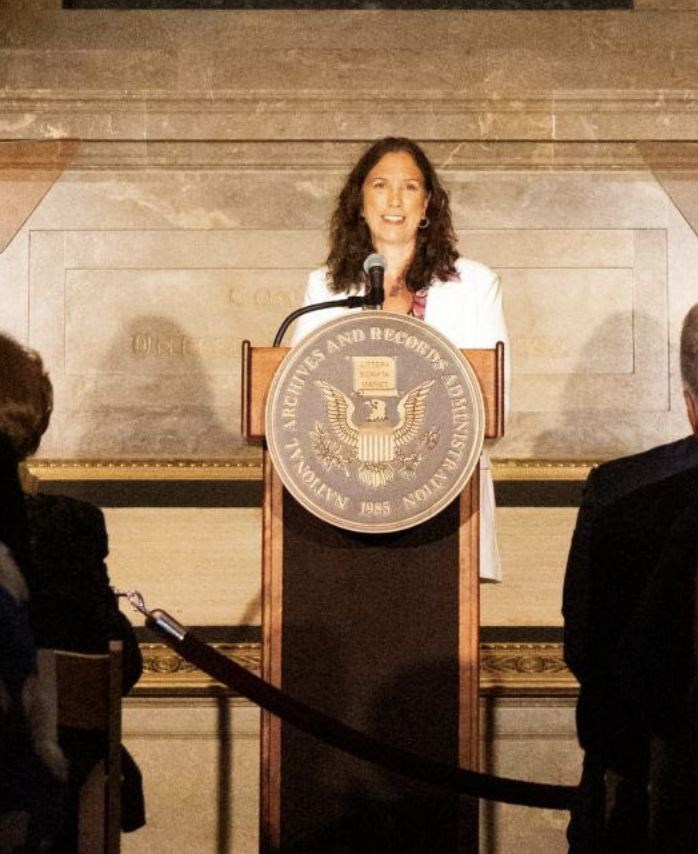
Ceremonial Swearing-in of 11th AOTUS, Dr. Colleen Shogan

On Monday, September 11, 2023, the National Archives and National Archives Foundation held a swearing-in ceremony for the 11th Archivist of the United States (AOTUS), Dr. Colleen Shogan. The ceremony was presided over by Chief Justice John G. Roberts, Jr., and First Lady Dr. Jill Biden gave keynote remarks.

First Lady Jill Biden spoke about the vast holdings of the National Archives and how they reflect us as a nation—“imperfectly marching toward a more perfect union.” As an educator, Dr. Biden also invoked the unofficial motto of the National Archives, what’s past is prologue, to affirm the importance of the institution’s role in learning our shared history. 

Dr. Shogan took her oath, administered by Chief Justice John G. Roberts, Jr., In an acknowledgment of the historic moment, she took the podium dressed in a white pantsuit, an homage to the suffragists who blazed the path for her and other women to not only participate in government, but also to lead it.

The archivist’s remarks laid out a bold future for the agency tasked with protecting and sharing our past. Prioritizing accountability, adopting new technology, and embracing creative outreach strategies were the main points of Dr. Shogan’s vision for the agency.

View the full remarks of Dr. Shogan here: https://www.archives.gov/about/speeches/shogan/swearing-in-ceremony

View the full remarks of Dr. Biden here: https://www.whitehouse.gov/briefing-room/speeches-remarks/2023/09/11/remarks-as-prepared-for-delivery-by-first-lady-jill-biden-at-the-swearing-in-ceremony-for-the-national-archivist/

Text and photo courtesy National Archives Foundation, https://www.archivesfoundation.org/shogan-swearing-in/?goal=0_c756ed33da-436145da69-55221835&mc_cid=436145da69&mc_eid=60901072c3

Meet the Archivist: An Interview with Archivist of the United States, Dr. Colleen Shogan, July 24, 2023, at 5:00 p.m. EDT (virtual)

You are invited! Join National Archives Foundation Executive Director Patrick Madden for a fireside chat with the new Archivist of the United States, Dr. Colleen Shogan. Viewers will learn more about her background and her vision for the National Archives. The discussion will be followed by an audience Q&A. The event is online, free, and scheduled for Monday, July 24, 2023, at 5:00 p.m. Eastern Daylight Time. Register and submit your questions for Dr. Shogan at https://www.archivesfoundation.org/event/meet-the-archivist-an-interview-with-national-archives-foundation-executive-director-patrick-madden-and-archivist-of-the-united-states-dr-colleen-shogan/

Alien Enemy Index, 1917-1919, is Now Online

The National Archives and Records Administration (NARA) recently completed digitization of the Alien Enemy Index, 1917–1919 (National Archives Identifier [NAID] 602456), that contains 57,722 index cards that document U.S. government interest in – and actions concerning – enemy aliens during the First World War.  Enemy aliens were citizens of the German Empire, Austria-Hungary, Bulgaria, and the Ottoman Empire. You can read more about this index and the related records at “The Alien Enemy Index, 1917-1919, is Now Digitized!” at https://historyhub.history.gov/genealogy/b/genealogy-blog/posts/the-alien-enemy-index-1917-1919-is-now-digitized.

The map below, courtesy of Australia’s Digital Classroom, shows the European boundaries of the Central Powers whose citizens were considered enemy aliens.

Search Tips: When searching the Enemy Alien Index in NARA’s Catalog, keep in mind that the first name of some aliens are abbreviated, such as “Chas.” for Charles or “Robt.” for Robert. Therefore, if searching by first and last name yields no results, search by surname only, or even by first name only for unusual first names.  Also consider searching by alternate spellings of a surname if you get no results.  In addition, some women are listed by their husband’s name, such as Mrs. Theodore Zeigler (NAID 296756836). You can also browse through an entire file unit (there are 23 file units), but be sure to set the “Sort by” order to either “Title (Alphabetically, A-Z)” or “Title (Alphabetically, Z-A)” instead of “Most Relevant.”    

Map URL: https://digital-classroom.nma.gov.au/images/map-showing-first-world-war-alliances

A Gem You’ve Never Heard Of

OK, before I tell you what the gem is, I need to give you a little background.

Did you know that the National Archives includes a library within its walls? Yes, indeed: It’s the “Archives Library Information Center” which has the acronym of ALIC.  It’s at the National Archives at College Park, Maryland (“Archives 2”), and is open to researchers as well as staff.  ALIC’s collections focus on archival science and books and periodicals relating to the records in NARA’s custody.

Neither you or I have time to read all the historical periodicals currently being published for great articles about persons, places, things, or events pertinent to the lives of our ancestors.  ALIC’s librarian does a little bit of that work for you, however, by compiling a Quarterly Compilation of Periodical Literature that focuses on identifying articles that cite records in NARA’s custody.  That means footnotes that might lead you to more information!

The Quarterly Compilation of Periodical Literature: 2022 (https://www.archives.gov/research/alic/periodicals/nara-citations/2022) includes – for just the first three quarters of this year – 454 articles on a broad range of topics, such as:

  • The dimensions of a Continental Army haversack like one your ancestor may have lugged around during the Revolutionary War.
  • The forgotten black coal miners of southern Wyoming.
  • Addiction to opium by Civil War veterans.
  • Marine Corps justice during the Civil War.
  • Federal compensation for property lost during the War of 1812.
  • Sicilian immigration to Braxos County, Texas, 1871-1921.

Each entry in the Quarterly Compilation includes the author; article title; journal with volume, page numbers, and date of publication; and the NARA Record Groups (RGs) or presidential libraries cited by the author. One example would be:  “Becker, Ann.  “The Revolutionary War Pension Act of 1818.”  Historical Journal of Massachusetts 47, no. 2 (Summer 2019): 98-137.  RG015/RG046/RG233.”

The Quarterly Compilation dates all the way back to 2010.  In addition to these annual lists, however, the ALIC librarian has also compiled the articles into lists by Presidential Library or Record Group cluster, such as Genealogical, Old Army, Old Navy, Maritime, and many others.  These lists can help you hone in on specific topics of interest.

Now what?  You’ve searched the lists and made note of some great-sounding articles.  What then?  The reference librarian and/or Inter-Library Loan (ILL) Librarian at your own public library should be able to help you locate online or obtain off-line copies of the articles.  Still having trouble?  Reach out to the ALIC librarian; there’s an email address on the main ALIC webpage.

ALIC-QComp

David S. Ferriero, 10th Archivist of the United States, Retired on April 30, 2022

David S. Ferriero, 10th Archivist of the United States, retired on April 30, 2022, after 12 years at the helm of the National Archives and Records Administration. A final interview conducted by staff member Victoria Malachi is available on YouTube. Debra Steidel Wall will serve as Acting Archivist until the next Archivist is nominated by the President and confirmed by the U.S. Senate.