Closed for Now, But Absolutely Essential

Last week I had great pleasure doing several hours of research in the National Archives Building in Washington, DC. My research took me into specialized War of 1812 and Civil War records that are not digitized – and that are not on anyone’s radar to digitize anytime soon – as there are over 11 billion textual pages that have not yet been digitized and there must be priorities for a gargantuan task like that.

Yesterday, October 1, 2025, the federal government “shut down” and will remain shut down until the President and Congress agree to funding for government agencies for Fiscal Year 2026, which began on October 1. This is the 11th time since 1980 that a shutdown involved furloughs of federal employees. This is no way to run a modern first world country. We can do better.

During a “shutdown” only so-called “essential” employees are allowed and required to work. All others are deemed “nonessential” for the purposes of the shutdown.

What does a shutdown mean for the National Archives and Records Administration? From my perspective, it means that there are only a FEW people who are allowed and required to work: (1) security personnel who maintain the security of the buildings, (2) building personnel who maintain and monitor HVAC and similar systems, and (3) limited numbers of senior management personnel. Those are the types of people deemed “essential.” Obviously, those persons are not doing archival work for you. They are not answering your emails, retrieving records, staffing the research rooms, preparing records for digitization, or digitizing records. Nope, they’re just “keeping the lights” on, so to speak.

Let’s be real. All the people who are deemed “nonessential” for the purposes of the shutdown are, in fact, absolutely essential to the mission of NARA. They are the ones who do the real archival work serving the American people, from maintaining and enhancing computer systems, adding information (descriptions) and digital images into the National Archives Catalog, answering your questions, retrieving (later refiling) records from storage areas so that researchers can view them in research rooms, staffing research rooms, performing document conservation (repairs), creating museum exhibits, and a myriad of other necessary tasks. These employees are dedicated, hard-working people that would rather be at the office working for you than sitting at home waiting for the “shutdown” to end.

The shutdown means that:

(1) No one can visit the Charters of Freedom – Declaration of Independence, Constitution, and Bill of Rights – and other exhibits in the National Archives Museum.

(2) No one can do research in person at the National Archives Building in Washington DC, the National Archives at College Park (Maryland), or National Archives field archives at Atlanta, Boston, Chicago, Denver, Fort Worth, Kansas City, Philadelphia, Riverside (California), San Francisco, Seattle, or Saint Louis.

(3) No one can visit the presidential museums of the modern presidents – Hoover, Roosevelt, Truman, Eisenhower, Kennedy, Johnson, Nixon, Ford, Carter, Reagan, G. H. W. Bush, Clinton, or G. W. Bush.

(4) No one can do research at the presidential libraries of the modern presidents – Hoover, Roosevelt, Truman, Eisenhower, Kennedy, Johnson, Nixon, Ford, Carter, Reagan, G. H. W. Bush, Clinton, G. W. Bush, or request access to undigitized records from the digital presidential libraries of Obama, Trump, or Biden.

(5) Your questions – sent by email, snail mail, telephone, or fax – will not be answered until the shutdown is over.

The full staff of the National Archives and Records Administration provides essential services to the American people. In a democracy, records belong to the people, and for more than 90 years, NARA has preserved and provided access to the records of the federal government of the United States of America. Records help us claim our rights and entitlements, hold our elected officials accountable for their actions, and document our history as a nation. In short, NARA ensures continuing access to the essential documentation of the rights of American citizens and the actions of their government. NARA holds in trust for the public the records of ordinary citizens—for example, military records of the brave men and women who have fought for our country, naturalization records of the immigrants whose dreams have shaped our nation, and even the canceled check from the purchase of Alaska. Learn more at “About the National Archives of the United States.”

The American people deserve to have a fully-funded, fully-staffed National Archives and Records Administration. Learn more at fundNARA.com and join the conversation at the webinar, “Fund America’s Stories: Advocacy and the National Archives” on Tuesday, October 7, 2025, at 3 pm ET.
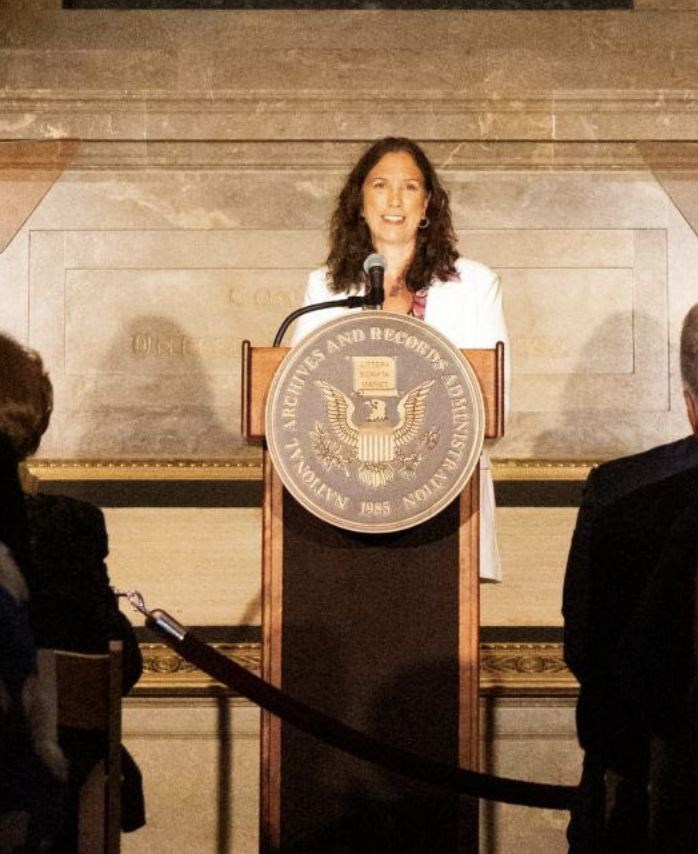
Ceremonial Swearing-in of 11th AOTUS, Dr. Colleen Shogan

On Monday, September 11, 2023, the National Archives and National Archives Foundation held a swearing-in ceremony for the 11th Archivist of the United States (AOTUS), Dr. Colleen Shogan. The ceremony was presided over by Chief Justice John G. Roberts, Jr., and First Lady Dr. Jill Biden gave keynote remarks.

First Lady Jill Biden spoke about the vast holdings of the National Archives and how they reflect us as a nation—“imperfectly marching toward a more perfect union.” As an educator, Dr. Biden also invoked the unofficial motto of the National Archives, what’s past is prologue, to affirm the importance of the institution’s role in learning our shared history. 

Dr. Shogan took her oath, administered by Chief Justice John G. Roberts, Jr., In an acknowledgment of the historic moment, she took the podium dressed in a white pantsuit, an homage to the suffragists who blazed the path for her and other women to not only participate in government, but also to lead it.

The archivist’s remarks laid out a bold future for the agency tasked with protecting and sharing our past. Prioritizing accountability, adopting new technology, and embracing creative outreach strategies were the main points of Dr. Shogan’s vision for the agency.

View the full remarks of Dr. Shogan here: https://www.archives.gov/about/speeches/shogan/swearing-in-ceremony

View the full remarks of Dr. Biden here: https://www.whitehouse.gov/briefing-room/speeches-remarks/2023/09/11/remarks-as-prepared-for-delivery-by-first-lady-jill-biden-at-the-swearing-in-ceremony-for-the-national-archivist/

Text and photo courtesy National Archives Foundation, https://www.archivesfoundation.org/shogan-swearing-in/?goal=0_c756ed33da-436145da69-55221835&mc_cid=436145da69&mc_eid=60901072c3

2023 National Archives Genealogy Series

NARA’s 2023 National Archives Genealogy Series, https://www.archives.gov/calendar/genealogy-series/2023, which begins on YouTube on May 3 and continues through June 14, will focus this year on military and civilian public service. The following presentations are scheduled to premiere:

May 3 at 1 p.m. ETWelcome and Introductions – Acting Archivist Debra Wall
May 3 at 1:05 p.m. ETCivilians at War:  Records of Participation in U.S. Military Conflicts – Claire Kluskens
May 10 at 1 p.m. ETBasic Military Records at the National Archives: Revolutionary War to 1917 – John Deeben
May 17 at 1 p.m. ETNational Archives at St. Louis: Understanding the 1973 Fire and Its Impact on Genealogical Research – Eric Kilgore
May 31 at 1 p.m. ETCivilian Conservation Corps Indian Division on the Reservation – Cody White
June 7 at 1 p.m. ETAccessing and Understanding Korean War Army Unit Records – Rachel Salyer
June 14 at 1 p.m. ETPlanning, Techniques, and Strategies for Preserving Family Collections and Stories – Sara Holmes
June 14 at 1:55 p.m. ETClosing Remarks – Chris Naylor

The presentations will be pre-recorded but the speakers will answer questions in the chat for 10 minutes at the end of the premiere. The videos will remain online on YouTube afterwards. Links to the videos and associated handouts are at NARA’s 2023 National Archives Genealogy Series.

See you online!

Updated 4 May 2023

Premiering Today, June 1, 2021, at 1 p.m. Eastern: “From Here to There: Researching Office of Indian Affairs Employees”

Premiering today, June 1, 2021, at 1 p.m.! Researching ancestors who worked for federal agencies is a popular topic at the National Archives and Records Administration (NARA). This presentation will tie together the Bureau of Indian Affairs (BIA) Official Personnel Files (OPF) held in St. Louis with agency records located in various NARA field sites.

The session will open with what can be found in the OPFs and how to request them. Cara Moore Lebonick, Reference Archives Specialist from the National Archives at St. Louis, Missouri, will conduct a deep dive into several OPF’s of Native women employed by the BIA.

Cody White, Archivist and Native American Related Records Subject Matter Expert from the National Archives at Denver, Colorado, will then explore how further information can be found in the regional records of the BIA.

Together Cara and Cody will show how the holdings across the National Archives can provide a more complete genealogical story.

NARA 2021 Genealogy Series

National Archives Hosts Genealogy Series in May & June 
Participate in our genealogy series – free and online!
 

WHAT:  WASHINGTON, April 19, 2021–In lieu of the autumn 2020 Virtual Genealogy Fair that could not be held due to the COVID-19 pandemic, we are pleased to offer a new Genealogy Series! Instead of a single-day event, the program sessions will be broadcast individually during May and June. You are invited to watch and participate in real time with the presenters and family historians from around the world on YouTube

Over the two months, the sessions will offer family history research tools on federal records for all skill levels. The May sessions are broad and will appeal to the beginner and beyond. The June sessions are focused on specific topics and may be better suited for the experienced researcher. All are welcome! Session descriptions, videos, handouts, and participation instructions are available at the Genealogy Series web page.  

WHEN: May & June—all sessions begin at 1 p.m. ET

May 4 Preserving and Digitizing Personal Photo Albums and Scrapbooks

May 12 Finding Genealogy Resources and Tools on Archives.gov

May 19 Tips and Tools for Engaging Family with Your Research Finds

June 1  From Here to There: Researching Office of Indian Affairs Employees

June 8  Civil War Union Noncombatant Personnel: Teamsters, Laundresses, Nurses, Sutlers, and More

June 15  Merchant Marine Records at the National Archives at St. Louis 


WHO: Staff experts in government records from National Archives facilities nationwide.

WHERE: Anywhere! The series will be broadcast on the U.S. National Archives YouTube channel
 

HOW: Visit the Genealogy Series web page to watch the broadcasts on YouTube. Participants can watch individual sessions, download materials, ask questions, and interact with presenters and other family historians. No need to register—just click the links on the schedule to view the sessions!  Videos and handouts will remain available after the event.  

Captioning:  Live captioning will be available online with StreamText. If you require an alternative or additional accommodation for the event, please email KYR@nara.gov.

Background: The National Archives holds the permanently valuable records of the federal government. These include records of interest to genealogists, such as pension files, ship passenger lists, census, and Freedmen’s Bureau materials. See “Resources for Genealogists” online.

Follow the National Archives on Twitter @USNatArchives and join the Genealogy Series conversation using #GenieSeries2021.

19th and Early 20th Century Federal Employees

Researching the career of a 19th or early 20th century federal employee requires delving into specialized records. Twenty-three years ago my article, “Documenting the Career of Federal Employees” was published in NARA’s Prologue magazine. The advice given then is still relevant today. There are still three basic steps in this research process. What has changed is online access to publications, finding aids, and–to some extent–records.

Step 1: Determine When, Where, and By Whom Employed. The Official Register of the United States is still the basic resource for this task. You can read more about it in John P. Deeben’s 2004 article. Fortunately, many of them are now online on Hathitrust.org. This important step enables the researcher to identify the federal agency or agencies that employed the ancestor. Knowing the agency means the researcher can then identify the appropriate Record Group(s) of interest in the National Archives and Records Administration.

Step 2: Identify Records Series that Might Provide Information. In the days before digital access, researchers had to consult inventories, preliminary inventories, and other finding aids onsite at the National Archives, or find them in a library, or obtain copies of them to peruse at home. Now, nearly every record series for every Record Group can be found in NARA’s online Catalog. Although using the Catalog can be daunting, it is accessible from home, and at your convenience.

Step 3: Examine Relevant Records. In most cases, the researcher will have to examine these records onsite at the NARA facility that holds the records. However, online access is slowly increasing through (1) enhanced description and/or (2) digital images.

  • Enhanced Description provides detailed information to allow the researcher to decide whether the records will be useful. For example, each of the 22 files in the series, Records Relating to the Protection of Mail Transport by Armed Guards, 1926-1932 indicates which postmasters and post offices (primarily larger cities) are included in the series. Here is the direct link to the Indiana file as an example. The records can then be perused onsite in the National Archives Building, or specific records can be requested by mail. If your ancestor was the postmaster or a postal employee of that post office, the records will provide insight into some of the work processes involved at that post office.


Learning more about an ancestor’s federal career will add biographical details to incorporate into their life story. You’ll get to know that person better.