NARA 1950 Census Webpages Now Online

This week the National Archives launched several webpages devoted to the 1950 census, including the main page, 1950 Census Records, at https://www.archives.gov/research/census/1950. Information on these pages will undoubtedly evolve over time. The supporting informational pages include:

As noted on 1950 Census Records, you will be able to search the 1950 Census website by name and location beginning on Day 1 — April 1, 2022. To develop the initial name index, NARA used Amazon Web Services’ artificial intelligence / optical character recognition (AI/OCR) Textract tool to extract the handwritten names from the digitized 1950 Census population schedules. Because the initial name index is built on optical character recognition (OCR) technology, it will not be 100-percent accurate. The National Archives is asking for your help in submitting name updates to the index using a transcription tool that will be available on the 1950 Census website. You can help us improve the accuracy of the name index and make the records more accessible for everyone. More information on this volunteer opportunity will be forthcoming.

Researchers can learn more about this census from the 1950 Census blog posts at the History Hub and watch for news at National Archives News.

Tintypes and Photos in Civil War Pension Files

If you’ve ever wondered why some U.S. Civil War pension files have tintypes and photos – wonder no more! NARA archives specialist Jackie Budell details the reasons in three excellent recent blog posts at The Text Message:

(1) Civil War-Era Personal Tintypes Exposed: Your Questions Answered

(2) Civil War-Era Personal Tintypes Exposed: Why Private William Carman Sent a Tintype to His Wife

(3) Civil War-Era Personal Tintypes Exposed: Why William Carman’s Tintype Was in His Widow’s Pension File

Exciting 1950 Census News from NARA

When the 1950 Census becomes available on a NARA website on April 1, 2022, there will be a name search function powered by an Artificial Intelligence/Machine Learning (AI/ML) and Optical Character Recognition (OCR) technology tool. Granted, it will be imperfect on opening day – but that just means that all of us will have the opportunity to make it better through a transcription tool that will also be available. Exciting times! Read more about it at 1950 Census Release Will Offer Enhanced Digital Access, Public Collaboration Opportunity, a December 14, 2021 press release.

National Archives Catalog Email Newsletters

The staff of the National Archives Catalog has a bimonthly newsletter to which anyone can subscribe; a pop-up invitation appears just about every time you visit the basic Catalog search page at https://catalog.archives.gov.

Recent past issues of the newsletter are archived here: https://us11.campaign-archive.com/home/?u=bfeaf03e7b0b1636c0b375892&id=921cecd7dd.

Upcoming California Genealogical Society Programs

The California Genealogical Society has a number of great online programs scheduled for the next several weeks. Check them out here. There’s even one called “Using the National Archives Websites (Plural)” tomorrow, Tuesday, June 15, 2021, at 9 p.m. Eastern (6 p.m. Pacific) that will be presented by a NARA staff member.

Extension Service Motion Pictures Digitized

It’s not considered one of the “traditional” genealogy record groups, but Record Group 33, Records of the Extension Service, is a treasure trove of information about farm life across the United States from about 1910 to 1950 or so. Even if one’s own ancestors are not mentioned in the records, they provide excellent county-level context on rural life. I lectured on these records on the 2011 NARA genealogy fair and have written about them a couple times, as well. My research guide, Agricultural Extension Service Annual Reports, 1909-1968, and Related Records will help you get started.

NARA is working on digitizing the the Service’s microfilmed annual reports (ca. 1908-1944) so they are not yet available online. I am delighted to report, however, that nearly 350 motion picture films from RG 33 have been digitized and are available for viewing or download from the National Archives Catalog. (Some may be restricted by copyright or other intellectual property right restrictions.) Happy viewing!

Premiering Today, June 1, 2021, at 1 p.m. Eastern: “From Here to There: Researching Office of Indian Affairs Employees”

Premiering today, June 1, 2021, at 1 p.m.! Researching ancestors who worked for federal agencies is a popular topic at the National Archives and Records Administration (NARA). This presentation will tie together the Bureau of Indian Affairs (BIA) Official Personnel Files (OPF) held in St. Louis with agency records located in various NARA field sites.

The session will open with what can be found in the OPFs and how to request them. Cara Moore Lebonick, Reference Archives Specialist from the National Archives at St. Louis, Missouri, will conduct a deep dive into several OPF’s of Native women employed by the BIA.

Cody White, Archivist and Native American Related Records Subject Matter Expert from the National Archives at Denver, Colorado, will then explore how further information can be found in the regional records of the BIA.

Together Cara and Cody will show how the holdings across the National Archives can provide a more complete genealogical story.

Resubscribe to NARA Blogs!

If you’re a regular NARA blog subscriber, you may have noticed that your expected new post notifications haven’t been arriving in your inbox lately. The problem seems to be part of some larger technical issues experienced during the recent migration from the commercial WordPress.com hosting solution to NARA’s own Amazon Web Services (AWS) cloud space. While the blogs still use WordPress-created software, NARA lost access to a number of premium features due to the move, and it appears that the subscriber lists were affected. NARA is working on resolving these issues as quickly as possible, but if you want to ensure that you don’t miss another post, your best bet is to resubscribe to your favorite blogs manually.

NARA implemented a simple double opt-in system that will ask you to confirm your subscription request via an email link. While this is an extra step for readers, it will help cut down on the vast quantity of spam the blogs receive and lets NARA be sure that its subscriber lists represent real people who care about the work being done at NARA.

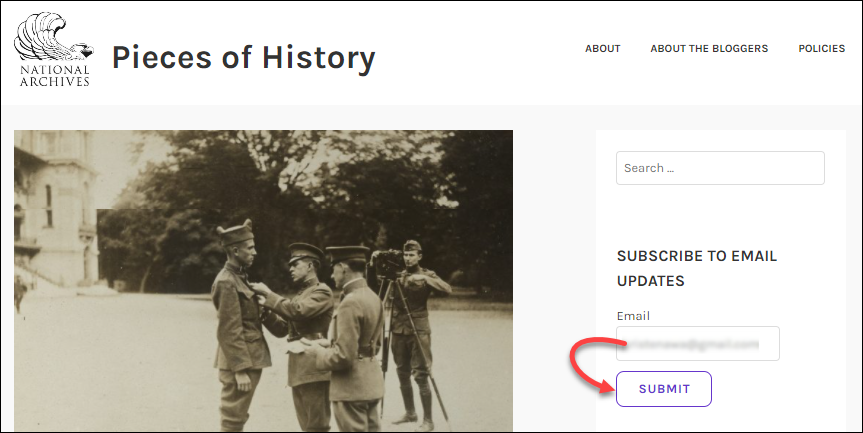
To sign up for notifications, visit each blog homepage and enter your email in the Subscribe to Email Updates box in the right hand side bar, and click the Submit button.

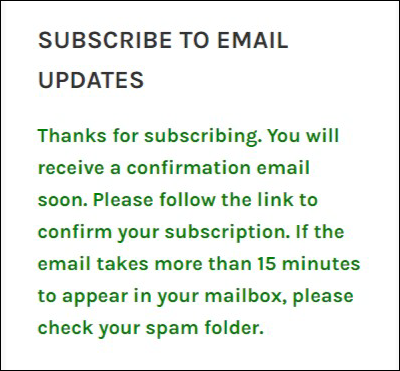
Once you submit your address, you’ll get a message alerting you to check your email for a confirmation link.

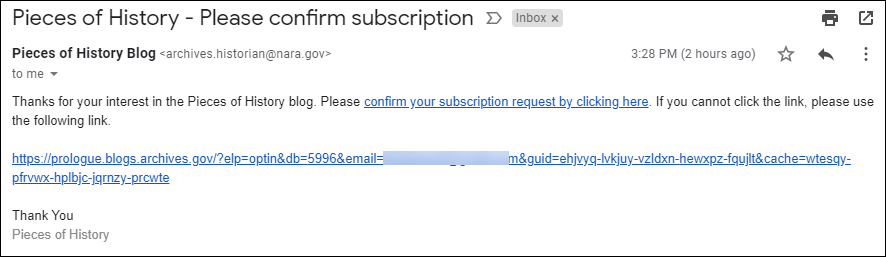
Please check your email and follow the link to confirm your subscription.


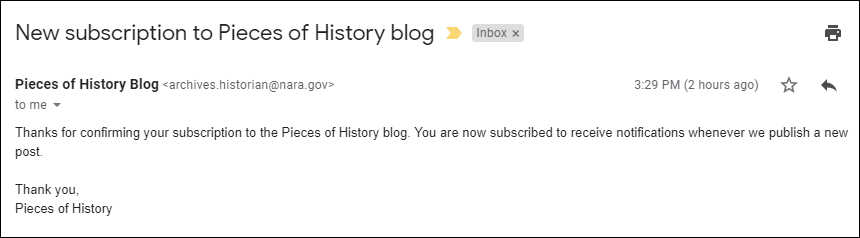
You’ll then receive a final email thanking you for your confirmation.

If you have any questions or run into problems during the process, please email socialmedia@nara.gov, and we’ll make sure you’re successfully signed up.