Digitization Update on War of 1812 Pension Files

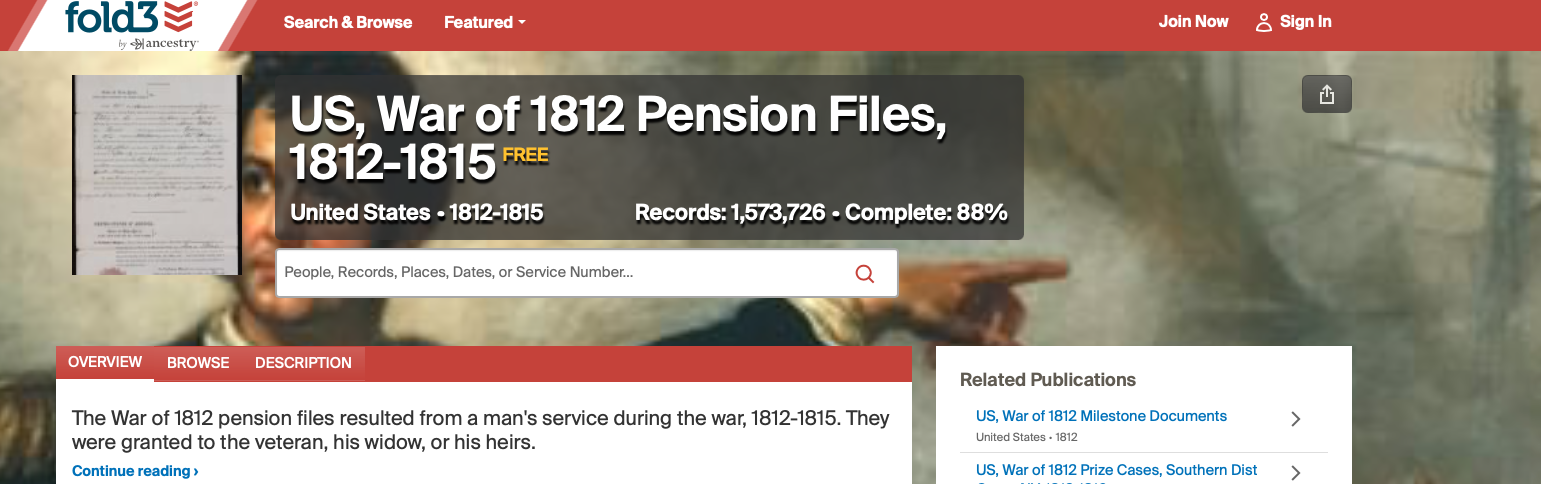
The National Archives and Records Administration, in partnership with Fold3.com, recently finished digitizing all files for surnames beginning with the letters “U” and “V”! All files from surnames A to V are free for viewing at Fold3.com at https://www.fold3.com/publication/761/us-war-of-1812-pension-files-1812-1815.

War of 1812 Pension Files Search Page on Fold3.com

In addition, War of 1812 pension files from A to Laughlin are free for viewing and download at the National Archives Catalog at “War of 1812 Pension and Bounty Land Warrant Application Files, ca. 1871-ca. 1900” (National Archives Identifier 564415), https://catalog.archives.gov/id/564415. Additional files will be uploaded to the NARA Catalog in the future.

War of 1812 Pension Files Description and Search Box at catalog.archives.gov

Digitizing of files for surnames beginning with the letter “W” began in September but is now halted due to the federal government shutdown.

If War of 1812 pension records – or other records at NARA – are important to you, please contact your Representative in Congress and your Senators to let them know how important these records are to you, personally. Please ask for full funding for NARA and request that they end the government shutdown so that federal employees can get back to doing work that you personally care about.

Closed for Now, But Absolutely Essential

Last week I had great pleasure doing several hours of research in the National Archives Building in Washington, DC. My research took me into specialized War of 1812 and Civil War records that are not digitized – and that are not on anyone’s radar to digitize anytime soon – as there are over 11 billion textual pages that have not yet been digitized and there must be priorities for a gargantuan task like that.

Yesterday, October 1, 2025, the federal government “shut down” and will remain shut down until the President and Congress agree to funding for government agencies for Fiscal Year 2026, which began on October 1. This is the 11th time since 1980 that a shutdown involved furloughs of federal employees. This is no way to run a modern first world country. We can do better.

During a “shutdown” only so-called “essential” employees are allowed and required to work. All others are deemed “nonessential” for the purposes of the shutdown.

What does a shutdown mean for the National Archives and Records Administration? From my perspective, it means that there are only a FEW people who are allowed and required to work: (1) security personnel who maintain the security of the buildings, (2) building personnel who maintain and monitor HVAC and similar systems, and (3) limited numbers of senior management personnel. Those are the types of people deemed “essential.” Obviously, those persons are not doing archival work for you. They are not answering your emails, retrieving records, staffing the research rooms, preparing records for digitization, or digitizing records. Nope, they’re just “keeping the lights” on, so to speak.

Let’s be real. All the people who are deemed “nonessential” for the purposes of the shutdown are, in fact, absolutely essential to the mission of NARA. They are the ones who do the real archival work serving the American people, from maintaining and enhancing computer systems, adding information (descriptions) and digital images into the National Archives Catalog, answering your questions, retrieving (later refiling) records from storage areas so that researchers can view them in research rooms, staffing research rooms, performing document conservation (repairs), creating museum exhibits, and a myriad of other necessary tasks. These employees are dedicated, hard-working people that would rather be at the office working for you than sitting at home waiting for the “shutdown” to end.

The shutdown means that:

(1) No one can visit the Charters of Freedom – Declaration of Independence, Constitution, and Bill of Rights – and other exhibits in the National Archives Museum.

(2) No one can do research in person at the National Archives Building in Washington DC, the National Archives at College Park (Maryland), or National Archives field archives at Atlanta, Boston, Chicago, Denver, Fort Worth, Kansas City, Philadelphia, Riverside (California), San Francisco, Seattle, or Saint Louis.

(3) No one can visit the presidential museums of the modern presidents – Hoover, Roosevelt, Truman, Eisenhower, Kennedy, Johnson, Nixon, Ford, Carter, Reagan, G. H. W. Bush, Clinton, or G. W. Bush.

(4) No one can do research at the presidential libraries of the modern presidents – Hoover, Roosevelt, Truman, Eisenhower, Kennedy, Johnson, Nixon, Ford, Carter, Reagan, G. H. W. Bush, Clinton, G. W. Bush, or request access to undigitized records from the digital presidential libraries of Obama, Trump, or Biden.

(5) Your questions – sent by email, snail mail, telephone, or fax – will not be answered until the shutdown is over.

The full staff of the National Archives and Records Administration provides essential services to the American people. In a democracy, records belong to the people, and for more than 90 years, NARA has preserved and provided access to the records of the federal government of the United States of America. Records help us claim our rights and entitlements, hold our elected officials accountable for their actions, and document our history as a nation. In short, NARA ensures continuing access to the essential documentation of the rights of American citizens and the actions of their government. NARA holds in trust for the public the records of ordinary citizens—for example, military records of the brave men and women who have fought for our country, naturalization records of the immigrants whose dreams have shaped our nation, and even the canceled check from the purchase of Alaska. Learn more at “About the National Archives of the United States.”

The American people deserve to have a fully-funded, fully-staffed National Archives and Records Administration. Learn more at fundNARA.com and join the conversation at the webinar, “Fund America’s Stories: Advocacy and the National Archives” on Tuesday, October 7, 2025, at 3 pm ET.

HARPPing on History

HARPPing on History is the official Substack (blog) of the Historical Archives and Preservation Project (HARP), which is an initiative led by the Organization of American Historians to ensure that U.S. history remains accessible, evidence-based, and accurate. I strongly invite all genealogists and persons interested in U.S. history to subscribe to it.

This week, professional genealogist Renée K. Carl, wrote an insightful article, With NARA Funding Cuts, Access to America’s Memory is on the Chopping Block,” that I strongly suggest you read. NARA has been underfunded for decades. Meanwhile, the deluge of electronic and paper records continues – but the proposed budget for federal fiscal year 2026 (October 2025 to September 2026) includes a 10 percent overall cut and a staggering 33 percent cut to funding for electronic records programs. So…. what does that mean? It’s worse than you think. Funding for digital assets would plummet to 56 percent less than it was 20 YEARS ago – in fiscal year 2007. It also means that critical work needed on 250 years worth of paper records, such as preservation actions, description, preparation for digitization, and digitization, will slow to a crawl.

Did you know that a only a little over 3 percent of the 12 billion (and growing) estimated textual (paper) pages at NARA are digitized? NARA cannot do “more with less.” No one can do “more with less.” NARA can only do less with less funding.

Learn more and join the conversation in the free webinar, Fund America’s Stories–Advocacy and the National Archives, on Tuesday, October 7, 2025, at 3:00 ET, which will explore the vital role of the National Archives and Records Administration in preserving federal records and protecting access to America’s stories, learn about its origins, the Federal Records Act, the impact of proposed budget cuts, and how you can advocate for NARA’s future.

NARA Staff Honored at NGS Conference

The National Genealogical Society honored two National Archives and Records Administration (NARA) staff members on May 25, 2025, during its recent conference held at Louisville, Kentucky.

Deceased NARA employee James Worris Moore was elected to the National Genealogy Hall of Fame, which honors outstanding genealogists whose achievements in American genealogy have had a great impact on the field and who have been deceased for at least five years. Their contributions to genealogy in this country need to be significant in a way that was unique, pioneering, or exemplary. Entries are judged by a panel of genealogists from various parts of the United States.

Mr. Moore was born in 1930 in North Carolina and died in 2019 in Maryland. During his 42-year career at the National Archives (1956-1998), he was a tireless advocate for genealogical research and record preservation. He was dedicated to ensuring public access to historical records, particularly military and pension files.

Moore began his career at the National Archives as an archivist in the old military reference section. Within a few years, he became chief of the military service staff and oversaw the handling of military service and pension file requests. Later, as director of the audiovisual archives division, he championed the use and preservation of underutilized audiovisual collections, including movies.

Moore was an indefatigable advocate for public access to genealogical records. During the early 1980s, when the US economy was in a severe recession, the National Archives could no longer afford to lend census microfilm to libraries. Moore understood how important these records were to genealogists. He proposed working with private companies to maintain accessibility for researchers. In 1984 the scope of his influence expanded when he was named assistant archivist for the newly established Office of Records Administration. During his time at the Office of Records Administration, he played a role in decisions regarding the retention of federal documents. Thanks to his lifelong work in archival service, Moore ensured that future generations could access a wealth of invaluable genealogical records. Well known genealogist Bernice Alexander Bennett read a letter of appreciation from Mr. Moore’s family.

Archivist Claire Kluskens, who recently retired from NARA as its subject matter expert for genealogy and census-related records, was a recipient of the NGS Fellow (FNGS) award, which recognizes outstanding work in service to NGS and in the field of genealogy. She published 60 articles in the NGS Magazine and NGS Quarterly and a similar number in local and state genealogical journals and other publications.

Two National Archives staff members previously received the FNGS designation:

(1) James Dent Walker (1978), who worked for the National Archives from 1944 to 1946, 1951 to 1957, and from the 1960s to 1979, was a nationally recognized authority on records in the National Archives useful for genealogical research. In particular, he specialized in military records, African-American genealogy, and was involved in the Archives’ genealogy education programs. In addition, founded the Afro-American Historical and Genealogical Society

(2) Meredith B. Colket, Jr. (1985), who worked at the National Archives from about 1941 to 1957, before serving as Director of the Western Reserve Historical Society (Cleveland, Ohio) from 1957 to 1980. In 1950, Colket founded and served as the first director of the genealogical education institute now known as the Genealogical Institute on Federal Records (Gen-Fed). He also coauthored the first edition, published in 1964, of the Guide to Genealogical Research in the National Archives.

Researcher Access to Archives 2 (College Park, Maryland) is Not Changing

From what I have seen on FaceBook this evening, June 24, NARA added some language to the Archives 2 webpage at https://www.archives.gov/college-park that caused a great deal of consternation today. While I believe that NARA was trying to be proactive, the language in question was very poorly worded, and therefore resulted in a lot of undue anxiety and (likely) anger. The problem language has been removed, so far as I can tell. The poor language stated, in part:

“Effective July 7, 2025, the National Archives at College Park, MD, will become a restricted-access federal facility with access only for visitors with a legitimate business need. It will no longer be open to the general public….”

Most genealogists and other researchers consider themselves to be members of “the general public” so it is very easy to understand the consternation that this statement created.

I am not employed by NARA, but please understand: Doing research in records at Archives 2 is still a valid reason for any person to go to Archives 2. No change.

What was that statement all about, then? Do random people (who don’t plan on doing research) randomly find their way to Archives 2 with the idea of entering the building? It has probably has happened. (Again, mere speculation: I have no knowledge.) There are no exhibits or museum areas for people to visit at Archives 2, so there is nothing for random people to do, except eat in the cafeteria.

Breathe. Stand down from red alert.

NARA’s 2025 Genealogy Series

The National Archives and Records Administration has announced the lineup of speakers and topics for its 2025 Genealogy Series. Presentations premiere at specific times but are then available 24/7 on YouTube. Mark your calendar now! It’s free! No registration required! This year’s schedule includes:

The U.S. National Archives Preserves and Provides Access to 250 Years of U.S. History

The National Archives is much more than the iconic Greek-revival style building situated on Pennsylvania Avenue near the National Mall.

The National Archives and Records Administration (NARA) holds in trust for the American people the permanently valuable records of the U.S. federal government that show our shared history over the past 250 years. NARA preserves and provides access to documents about the decisions and actions of government, rights of individuals (such as citizenship), or otherwise have sufficient historical or other value to warrant continued preservation. Genealogists, military veterans, historians, lawyers, and other researchers find the records essential to their research. Information about newly digitized records in the National Archives Catalog can be found at “What’s New in the National Archives Catalog.”

NARA preserves:

  • 11.9 billion pages of historic textual (paper records);
  • 10 million maps, charts, and architectural and engineering drawings;
  • 40 million still photographs, digital images, filmstrips, and other graphics;
  • 40 million aerial photographs dating to the 1930s;
  • 448 million feet of motion picture film;
  • 992,000 video and sound recordings; and
  • 837 terabytes of electronic data

The National Archives does this at different and necessary facilities that each hold unique records found nowhere else:

NARA has a staff of about 2,800 persons who are dedicated to serving the American people. Staff who work with the public develop expertise in specific bodies of records. Other staff have technical experience and knowledge that supports our mission to preserve the records and provide the public access to them. Learn more by reading a few employee profiles.

Congress established the National Archives nearly 90 years ago by a law known as the “The National Archives Act of 1934” that was signed on June 19, 1934. Since April 1, 1985, NARA has been governed by the “The National Archives and Records Administration Act of 1984” that was signed by President Ronald Reagan.

Come explore the records!

NARA’s Genealogy Series – May 21-June 25, 2024

NARA’s annual Genealogy Series features staff experts speaking about records in National Archives custody. The 2024 series begins on May 21. This year’s line up includes:

  • Passport Records: Passport Applications at NARA, 1790s-1925 – May 21, 1 p.m. ET
  • After Their Service: Tracing the Lives of Native American Army Scouts – May 28, 1 p.m. ET
  • Captured German Records Related to American Prisoners of War During World War II – June 4, 1 p.m. ET
  • Alien Files (A-Files): Researching Immigrant Ancestors at the National Archives – June 18, 1 p.m. ET
  • World War II Enemy Alien Records Related to Japanese Americans at the National Archives – June 25, 1 p.m. ET

Don’t worry about missing the program! After their premiere, these videos will remain online on YouTube for future viewing.