My colleague, Kaitlyn Enriquez, from NARA’s Still Pictures Branch, has provided an excellent informational guide in How to Research: Photographs Relating to World War II Navy Ships. Previous blogs provided information about researching WWII Army photographs and WWII Air Force (Army Air Corps) photographs.
Library of Congress Webinars Will Discuss World War I
Our friends at the Library of Congress will highlight the Library’s World War I resources with a series of five free 40-minute webinars in Summer and Fall 2017. Registration is required for each event. After the webinars, the Library will make recordings of the sessions available at their site. Check back two weeks after the event to access the webinar.
Titles of the webinars are:
• Echoes of the Great War: American Experiences of World War I
• Over Here, Over There: Immigrant Veterans of World War I
• Woodrow Wilson Chooses War
• Lest Liberty Perish: Joseph Pennell and World War I
• Charles Hamilton Houston & World War I
Additional information, including how to register, can be found at https://www.loc.gov/exhibitions/ world-war-i-american-experiences/events-and-resources/
Department of State Visa Records in the National Archives
My colleague, David Langbart, provides a great navigational guide to these 20th century records in his recent blog post: Department of State Visa Records in the National Archives.
Finding Nemo, Finding Amelia, Finding Your Family
In Finding Nemo, Marlin has many adventures in the big, wide ocean during his journey to rescue his son, Nemo, who was captured by a diver. The journey to his destination is neither straightforward or simple.
July 2017 marks the 80th anniversary of the disappearance of Amelia Earhart and Fred Noonan during their attempt to fly around the world. The public’s fascination with the mystery of their disappearance continues to spur researchers to explore the vast ocean of archival records for new clues, as well as to revisit records previously viewed by themselves or others for fresh perspectives.
Millions of people, including, hopefully, readers of this blog, search archival records for evidence of their ancestors’ lives. It’s a big ocean of records that’s getting easier to swim through. FamilySearch previously announced plans to digitize all its microfilm. Numerous commercial genealogy sites vie for your business. Publicly-funded libraries and archives continually add to their online records collections also. It pays to go back and revisit online collections for “new” information.
Have you tried the National Archives Catalog recently? There’s both a “basic” search and an “advanced search” function. Try them both. What will you find? There are now some 66 million entries in the National Archives Catalog, according to my best understanding of it. Those entries can be descriptions of governmental entities, record series, files from within those record entries, individual items, and digital images of actual records. There are also many bibliographic entries, such as persons, places, and subjects.
The journey to learning your ancestors’ life stories is often neither straightforward or simple. Like Marlin, you can’t stop in the middle of the ocean. Keep swimming, and keep searching in new places. Revisit what you’ve already found for new understandings.
The Story of the Video of the Famous Flag Raising
Everyone knows the famous photo, shown here. But have you seen the video, or know the story behind it?
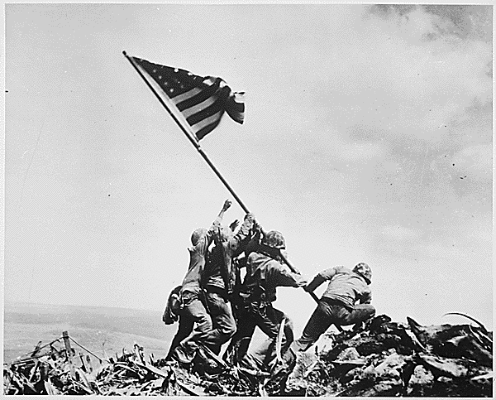
When the National Archives investigated the true identity of the flag raisers in Bill Genaust’s footage of the first and second Flag Raisings on Iwo Jima and the iconic photograph by Joe Rosenthal, staffers discovered that the agency never received the original film shot on February 23, 1945. Supervisory Motion Picture Preservation Specialist Chriss Kovac provides information about Bill Genaust and how the film was shot, developed, assembled, and used during the World War II and throughout history in this YouTube Video, “The Winding Journey of Bill Genaust’s Flag Raising Footage”
Spanish-American War Nurses
It’s become a little bit easier to research Spanish-American War nurses. The National Archives Catalog now identifies 761 women for whom there are correspondence files, primarily for those who wanted to obtain government benefits based on their service. These files are in the series, “Correspondence Relating to the Service of Spanish-American War Contract Nurses, 1898-1939,” which is in Record Group 112, Records of the Office of the Surgeon General (Army). The files themselves are not online, but copies can be requested from archives1reference@nara.gov.
To search for a specific person in the Catalog, you have two options. One option is to click on the catalog link that says “761 file unit(s) described in the catalog.” The files are in alphabetical order.
Here are the first four files:
The second option is to click on the button that says “Search within this series” THEN replace the *.* in the search bar with the surname of interest. Then click on the magnifying glass icon to perform the search. (Yes, that is not an intuitive process.)
Additional records about Spanish-American War nurses in RG 112 include “Personal Data Cards of Spanish-American War Contract Nurses, 1898-1939” (NARA staff has a list of nurses included in that series) and “Registers of Service of Spanish-American War Contract Nurses, 1898-1900.”
The Record isn’t Always Where You Expect to Find it.
April 14, 2017, marked the 105th anniversary of the sinking of the Titanic. Its passenger list went down with the ship.
However, some of its passengers were rescued by the Carpathia, and naturally, one would expect to find those persons listed on a passenger list. For many years, the Carpathia (Titanic) list was thought to be lost. In the 1990s, however, the list was discovered.
This list was erroneously filed by the Immigration and Naturalization Service with June 18, 1912, arrivals, and can be found in NARA microfilm publication T715, Passenger and Crew Lists of Vessels Arriving at New York, New York, 1897-1957, Roll 1883, Vol. 4183, which is online on various genealogy websites. A direct link to the individual Carpathia-Titanic passenger list pages is online at the National Archives website.
Marian L. Smith wrote an article on this rediscovery: “The RMS Titanic Passenger Manifest: Record of Survivors – and Revival of a Record,” Voyage (Journal of the Titanic International Society, Inc.), Volume 29 (1999), pp. 4-9.
The record you seek may not exist … but sometimes it’s hiding in plain sight. It pays to be creative and persistent.
World War I Records Online
April 6, 2017, marked the 100th anniversary of America’s entrance into the Great War. After remaining neutral for three years, the United States reluctantly entered what was supposed to be “The War to End All Wars.” By declaring war, President Woodrow Wilson committed the nation to join the other Allied countries in their efforts to defeat the German-led Central Powers.
As the largest repository of American World War I records, the National Archives invites you to browse the wealth of records and information documenting the U.S. experience in this conflict, including photographs, documents, audiovisual recordings, educational resources, articles, blog posts, lectures, and events from its new World War I Centennial portal. This portal links to selected digitized records.
A Look at Inauguration Day Through the Years: Inaugural Photographs and Facts
The U.S. Constitution only stipulates the date and time of the inauguration, as well as the words of the Presidential Oath of Office. Given this lack of detail, traditions surrounding the U.S. Presidential Inauguration have grown and evolved since Washington’s 1789 inauguration. In a look back at past inaugural ceremonies, the NARA Still Picture Staff presents photographs and facts covering Inauguration Day celebrations and traditions throughout the years in A Look at Inauguration Day Through the Years: Inaugural Photographs and Facts.
Minor’s Naturalization
While we normally think of naturalization as a two step process whereby the alien first declares his intent to become a citizen and then petitions for naturalization, there were exceptions to that procedure.
For example, from 1824 to 1906, aliens who came to the U.S. while under age 18 could effectively declare their intent to become a citizen at the same time they filed their petition for naturalization once they had reached age 21 or more and had lived in the U.S. for five years (three of which as a minor). Let the law speak for itself:
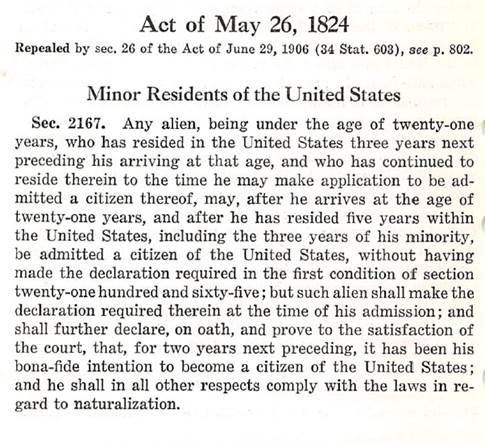 So, to summarize: the alien still had to meet the five year requirement for residency, and three years of that had to be while he was a minor.
Many courts used specific forms for these cases that combined declaration of intent language and petition language in one document, and they made sure to include the word “minor.” Some may say the applicant “arrived as a minor,” while others will have the words “Minor Naturalization” emblazoned across the title or as a watermark.
For more on naturalization, see Naturalization Records and Women and Naturalization, Part I and Part II.

