Digitization Update on War of 1812 Pension Files

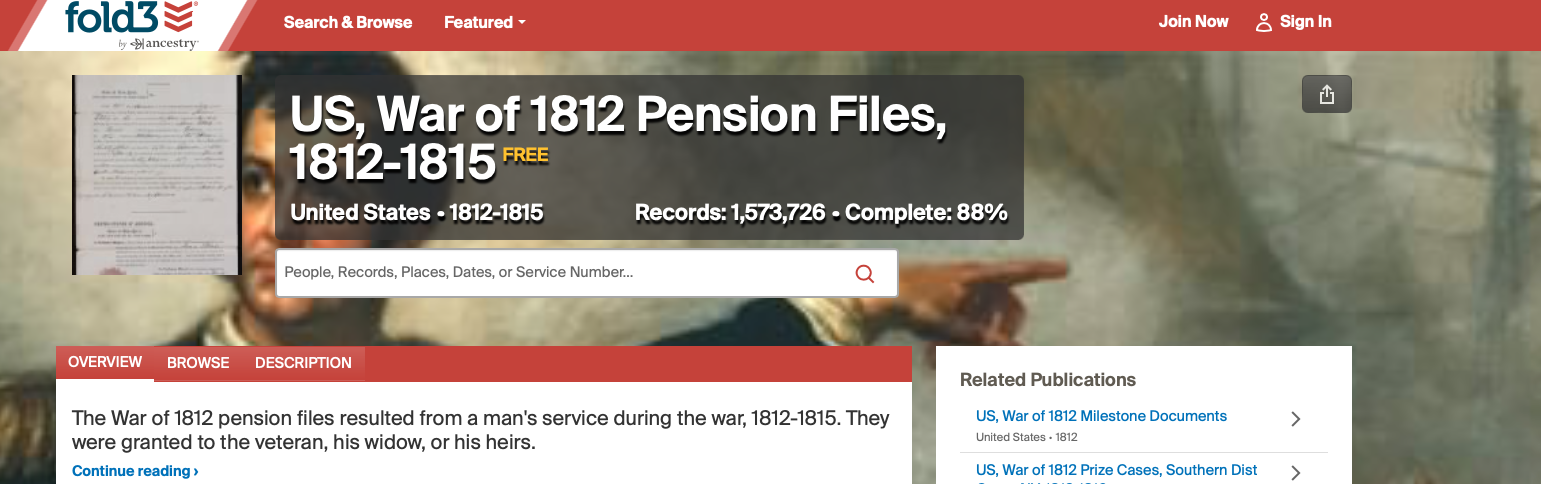
The National Archives and Records Administration, in partnership with Fold3.com, recently finished digitizing all files for surnames beginning with the letters “U” and “V”! All files from surnames A to V are free for viewing at Fold3.com at https://www.fold3.com/publication/761/us-war-of-1812-pension-files-1812-1815.

War of 1812 Pension Files Search Page on Fold3.com

In addition, War of 1812 pension files from A to Laughlin are free for viewing and download at the National Archives Catalog at “War of 1812 Pension and Bounty Land Warrant Application Files, ca. 1871-ca. 1900” (National Archives Identifier 564415), https://catalog.archives.gov/id/564415. Additional files will be uploaded to the NARA Catalog in the future.

War of 1812 Pension Files Description and Search Box at catalog.archives.gov

Digitizing of files for surnames beginning with the letter “W” began in September but is now halted due to the federal government shutdown.

If War of 1812 pension records – or other records at NARA – are important to you, please contact your Representative in Congress and your Senators to let them know how important these records are to you, personally. Please ask for full funding for NARA and request that they end the government shutdown so that federal employees can get back to doing work that you personally care about.

Infinite Diversity (Part I)

One of the most interesting things about records in the U.S. National Archives is almost infinite diversity of materials that can be found. This post will highlight several small record series that have been digitized.

Record Group 15, Records of the Department of Veterans Affairs, is well known for genealogical gems like military service and pension files, but it also contains a variety of other records:

  • Bibliography of Publications Concerning Inmates in Soldiers’ Homes, ca. 1913–ca. 1927, https://catalog.archives.gov/id/407305556.
  • Records Relating to the Delaney House, 1914, https://catalog.archives.gov/id/407302072. This was a building in Washington, DC, that was used as a hospital during the Civil War. 
  • Records Concerning Confederate Homes, 1919-1927, https://catalog.archives.gov/id/407302073, includes a list of Confederate homes existing at that time. 
  • Summary Lists of Certificate Numbers Assigned to Pensioned Veterans, Navy Widows, and Army and Navy Widows, 1816–1924,  https://catalog.archives.gov/id/400216432. This series contains typescript lists that identify the dates upon which certain pension certificate numbers were assigned to pensioned veterans (“invalids”), 1816-1924; Navy widows, 1862-1910; and to widows, 1862-1924. The “widows” list includes certificate numbers issued to Army widows for 1862-August 1910 and both Army and Navy widows for August 1910-June 1924. These lists likely served as a quick reference aid to the approximate date when a certificate was issued. For example, if one wanted to know when Widow’s Certificate (WC) 190,000 was issued, the widow’s certificate list indicates it was issued sometime between June 3, 1880, when 188,500 was issued, and June 3, 1881, when 192,500 was issued.

Record Group 64, Records of the National Archives and Records Administration (NARA) includes many NARA microfilm publications because they are NARA work product.

  • NARA Microfilm Publication M2156, Lists of Federal Prisoners of War Who Enlisted in the Confederate Army (1 roll, published 2012), https://catalog.archives.gov/id/470650567, was uploaded to the Catalog in RG 64 as National Archives work product but the images of records it contains are from Record Group 249, Records of the Commissary General of Prisoners.

Record Group 92, Office of the Quartermaster General

  • Annual Reports Relating to the Army Transport Service, 1901,  https://catalog.archives.gov/id/2662956. relates to quartermaster activities that supported the U.S. Army during the Philippine-American War.

Record Group 393, Records of U.S. Army Continental Commands

  • Census of Black Persons in Princess Anne County, Virginia, 1863, https://catalog.archives.gov/id/352794518, is a unique volume in NARA holdings. In this volume, H. H. Huff of Ovid, Seneca County, New York, recorded a census of black persons who resided in Princess Anne County, Virginia. Mr. Huff began taking the census on June 23, 1863, according to a paper glued to the inside front cover of the volume. The printed census form, which spans two facing pages, asked for each person’s name and the following information:
    • Sex – Male or female
    • Age – Under 10, 10 to 20, 20 to 45, or over 45
    • Condition – Bond (enslaved), free, or contraband
    • Residence – Permanent, transient, or how long within the lines
    • How Employed – On deserted farms, otherwise employed by the government, or not employed
    • Helped by the Government – Wholly or in Part
    • Color – Black or mixed Able to read [hash mark if yes]
    • Remarks – The “Remarks” column often indicates federal employment, either in general terms, such as “on entrenchment,” or specifically, such as “Ordnance Department.”
  • List of Prisoners at Fort Jefferson (Florida) on March 31, 1866,  https://catalog.archives.gov/id/404788116, includes Dr. Samuel Mudd and other persons who assisted John Wilkes Booth after the assassination of Lincoln, as well as other military prisoners.
  • Lists of Supplies on Hand, July 1847–October 1850 (at Fort Jefferson, Florida), https://catalog.archives.gov/id/404788104, could be of interest to military historians.

Record Group  395, Records of U.S. Army Overseas Operations and Commands, contains a lot of material relating to activities of both Filipino and U.S. personnel during the Philippine-American War, 1899-1902. These are just a few examples.

  • Card List of Batson’s Scouts, July 1901, https://catalog.archives.gov/id/467258916.
  • Register of a Census Taken in the Province of Tayabas, Philippines, June 1900–September 1900, https://catalog.archives.gov/id/400216440. Each entry includes the man’s name, age, marital status, bario of residence in Tayabas, occupation (“profession”), and the census certificate number and date of issuance. All the men were indicated to be natives of Luzon. No women are included.
  • Register of Native Prisoners Confined, October 1900-May 1902, https://catalog.archives.gov/id/404788077, primarily contains a list of native (Filipino) prisoners of war confined at Balayan, Batangas, Philippine Islands. The men were captured from October 1900 to July 1901 and released by May 1902. The information was recorded across two facing pages and usually includes including each man’s name, age, residence, date of capture and by which officer, cause for which held, and “disposition” that is usually the date of release from confinement.
  • Special Orders, May-September 1900, https://catalog.archives.gov/id/404788009, were issued by commanding officers of 4th U.S. Infantry from the “Headquarters, U.S. Troops” at Bacoor, Cavite, Philippines, and primarily concern special assignments of duty to specific military personnel.
  • Special Orders, May-July 1901https://catalog.archives.gov/id/404788041, were issued from the headquarters of the 1st Squadron, 4th U.S. Cavalry, at Badoc, Ilocos Norte, Philippines, and primarily concern special assignments of duty to specific military personnel.

Memorial Day Remembrance: Beneath His Shirt Sleeves

On this Memorial Day, as we remember the fallen heroes who sacrificed their lives to defend our freedoms and preserve one United States of America, I respectfully direct your attention to an excellent two-part article by archives specialist Jackie Budell entitled “Beneath His Shirt Sleeves: Evidence of Injury” with Part I here and Part II here. This article highlights the sacrifice and stories of eight Union Civil War veterans who lost most – or part – of an arm during their war service.

Tintypes and Photos in Civil War Pension Files

If you’ve ever wondered why some U.S. Civil War pension files have tintypes and photos – wonder no more! NARA archives specialist Jackie Budell details the reasons in three excellent recent blog posts at The Text Message:

(1) Civil War-Era Personal Tintypes Exposed: Your Questions Answered

(2) Civil War-Era Personal Tintypes Exposed: Why Private William Carman Sent a Tintype to His Wife

(3) Civil War-Era Personal Tintypes Exposed: Why William Carman’s Tintype Was in His Widow’s Pension File

Federal Records that Help Identify Former Slaves and Slave Owners

I gave a presentation with this title during the 2018 NARA Virtual Genealogy Fair which is online. I’ve now added the “June 2019” version of the handout for that presentation to my “Research Guides” page on this website. This handout highlights of federal agencies or major records series that are useful; it is certainly not exhaustive.

In addition, it is good to remember that most documentation of enslavement will be found in property, estate, tax, and other records created primarily at the county level, not in federal records.

Letters and Financial Reports, June-December 1870, and Letters and Endorsements Pertaining to Trusses, November 1875-July 1884, by Assistant Surgeon John S. Billings

There are now 26.7 million descriptions and 136 million digital objects (images) in the National Archives Catalog. Those figures will continue to grow.

One recently digitized series – that consists of just one item (one volume) – is the “Letters and Financial Reports, June-December 1870, and Letters and Endorsements Pertaining to Trusses, November 1875-July 1884, by Assistant Surgeon John S. Billings” (National Archives Identifier 15501038).

A truss is a prosthetic appliance used by a person with a hernia. The Act of Congress of May 28, 1872 (17 Statutes at Large 164), “An Act to provide for furnishing Trusses to disabled Soldiers,” entitled “every soldier of the Union army who was ruptured while in the line of duty” during the Civil War “to receive a single or double truss of such style as may be designated by the Surgeon-General of the United States Army as the best suited for such disability.” Section 2 of the act directed the soldier to make his request to “an examining surgeon for pensions” who would “prepare and forward the application” without charge. Section 3 of the act directed the Surgeon General to purchase trusses “at a price not greater than the same are sold to the trade at wholesale.”

This volume contains two different sets of fair copies of correspondence sent by Assistant Surgeon General and Brevet Lieutenant Colonel John S. Billings.

Pages 1-32 contain fair copies of correspondence sent by Dr. Billings from June 1, 1870, to December 31, 1870, and related records. These are letters to various payees who received government checks for services or supplies; suppliers of artificial limbs concerning limbs for specific veterans; and others. There are copies of receipts issued for money received from the sale of surplus U.S. Government property as well as weekly financial statements submitted to the Surgeon General concerning the financial condition of the Medical and Hospital Department, Army Medical Museum, Surgeon General’s Office Library, and the funds for the “Comfort of Sick and Discharged Soldiers.” Pages 23-32 (August 6 – December 31, 1870) consist solely of financial statements.

Pages 35-49 contain a name index arranged roughly alphabetical by the initial letter of the surname. Each entry includes the person’s name and the page number in this volume upon which correspondence was recorded.

Page 51-201 and 204-237 contain fair copies of letters sent and endorsements made by Dr. Billings concerning trusses from November 1875 to May 1884. Letters were recorded on the upper section of pages 51-71 while an endorsement on an unrelated matter was recorded sideways on the lower section of pages 51-58, 62-65, 70-71, 85, 100, 109, and 151, and sideways on the upper section of page 165. Letters addressed to manufacturers are primarily purchase orders or, in a few cases, complaints about specific truss models. Many letters to U.S. Pension Examining Surgeons and other physicians are notifications that individual soldiers were ineligible to receive a free replacement truss, while others address concerns about a truss issued to a particular pensioner. There is also correspondence with pensioners and the Pension Office. The endorsements copied into this volume were made on truss applications returned to examining surgeons with directions to obtain measurements necessary to provide the applicants with the correct size truss. A sample of the form of notice that the Act of May 28, 1872, permitted only one truss per soldier was inserted loosely at pages 358-359. Page 358 also contains a brief note in shorthand. For unknown reasons, an anatomical diagram of the “venus sinusesal base of brain” was inserted loosely at pages 360-361.

Pages 33-34, 202-203, 238-357, and 359 are blank.
Neighborly Deception and All Things Human

Stories about local personalities, estate sales, local events, long-forgotten conflicts and more…. You just never know what you will find by digging in unusual records. Find out more in “Mrs. Hartshorne’s Estate Sale and the Joking Neighbor of Patrick McGroury of Manalapan, New Jersey.”

That Pesky Issue of Spelling

As citizens of the 21st century, we often expect “precision” in names, dates, places, geographic locations, and many other things. For our ancestors, however, precision in such details was not as important as things like, “How many eggs did the chicken lay today?”

Although we ‘live by the clock’ our ancestors did not, or not so much, and a Norwegian island wants to try to go back to that during their longest days. (See New York Times article here).

But back to the name thing. Today’s blog post by Damian Shiels, “Leaving Off the ‘O'”: Insights into Irish Emigrant Name Changes in 1860s America” gives good food for thought regardless of your ancestors’ nationality.

As always, superior genealogical research requires an understanding of our ancestor’s perspective and worldview. It makes understanding the records a tad easier.

Burial Flags for U.S. Military Veterans

Today, when a U.S. military veteran dies, we take it for granted that the federal government will provide the next of kin with a U.S. flag to drape over the casket during funeral services. Obtaining this flag is one of the many routine tasks performed by funeral homes for grieving families.

But, did you know this? — The tradition of federally-funded flags for most veterans dates back only to the 1920s! You can read more about it in Records of Burial Flags for Veterans, NGS Magazine, Vol. 42, No. 4 (Oct.-Dec. 2016): 39-42.

flagdrapedcasket

Call Number 13

The near-infinite variety of records in military pension files is the very essence of a truism: a statement that is obviously true and says nothing new or interesting. And yet, of course, you do not know what will be in any particular pension file until you look. It is in looking that interesting things are found. Egads, another truism.

A Civil War (or later) veteran’s answer to “Call Number 13” is one of those interesting things that will only be found in certain Union Civil War pension files. You can read about Call 13 and the circumstances under which it is found in “Did Your Civil War Ancestor Respond to Call Number 13?” NGS Magazine, Vol. 42, No. 2 (Apr.-May 2016): 35-39.