Presentation Slides: https://www.archives.gov/files/calendar/genealogy-series/2024-06-04-presentation-salyer.pdf
Presentation Handout: https://www.archives.gov/files/calendar/genealogy-series/2024-06-04-handout-salyer.pdf
NARA has reintroduced a user-friendly “What’s New in the National Archives Catalog” page at https://www.archives.gov/research/catalog/whats-new. This webpage may highlight visually interesting items along with a list of:
The list shows the part of the NARA that holds the records and gives a direct link to where the records are in the Catalog. As should be expected, digital images of very large record series will usually be uploaded in increments over time (months or years), as digitization is accomplished. Digital images of very small series are normally uploaded all at once, such as the single volume series, List of Special Agents Who Collected Cotton Statistics, 1900 (National Archives Identifier 3318884).
What will you find that’s new and interesting to you?
NARA’s 2023 National Archives Genealogy Series, https://www.archives.gov/calendar/genealogy-series/2023, which begins on YouTube on May 3 and continues through June 14, will focus this year on military and civilian public service. The following presentations are scheduled to premiere:
| May 3 at 1 p.m. ET | Welcome and Introductions – Acting Archivist Debra Wall |
| May 3 at 1:05 p.m. ET | Civilians at War: Records of Participation in U.S. Military Conflicts – Claire Kluskens |
| May 10 at 1 p.m. ET | Basic Military Records at the National Archives: Revolutionary War to 1917 – John Deeben |
| May 17 at 1 p.m. ET | National Archives at St. Louis: Understanding the 1973 Fire and Its Impact on Genealogical Research – Eric Kilgore |
| May 31 at 1 p.m. ET | Civilian Conservation Corps Indian Division on the Reservation – Cody White |
| June 7 at 1 p.m. ET | Accessing and Understanding Korean War Army Unit Records – Rachel Salyer |
| June 14 at 1 p.m. ET | Planning, Techniques, and Strategies for Preserving Family Collections and Stories – Sara Holmes |
| June 14 at 1:55 p.m. ET | Closing Remarks – Chris Naylor |
The presentations will be pre-recorded but the speakers will answer questions in the chat for 10 minutes at the end of the premiere. The videos will remain online on YouTube afterwards. Links to the videos and associated handouts are at NARA’s 2023 National Archives Genealogy Series.
See you online!
Updated 4 May 2023
OK, before I tell you what the gem is, I need to give you a little background.
Did you know that the National Archives includes a library within its walls? Yes, indeed: It’s the “Archives Library Information Center” which has the acronym of ALIC. It’s at the National Archives at College Park, Maryland (“Archives 2”), and is open to researchers as well as staff. ALIC’s collections focus on archival science and books and periodicals relating to the records in NARA’s custody.
Neither you or I have time to read all the historical periodicals currently being published for great articles about persons, places, things, or events pertinent to the lives of our ancestors. ALIC’s librarian does a little bit of that work for you, however, by compiling a Quarterly Compilation of Periodical Literature that focuses on identifying articles that cite records in NARA’s custody. That means footnotes that might lead you to more information!
The Quarterly Compilation of Periodical Literature: 2022 (https://www.archives.gov/research/alic/periodicals/nara-citations/2022) includes – for just the first three quarters of this year – 454 articles on a broad range of topics, such as:
Each entry in the Quarterly Compilation includes the author; article title; journal with volume, page numbers, and date of publication; and the NARA Record Groups (RGs) or presidential libraries cited by the author. One example would be: “Becker, Ann. “The Revolutionary War Pension Act of 1818.” Historical Journal of Massachusetts 47, no. 2 (Summer 2019): 98-137. RG015/RG046/RG233.”
The Quarterly Compilation dates all the way back to 2010. In addition to these annual lists, however, the ALIC librarian has also compiled the articles into lists by Presidential Library or Record Group cluster, such as Genealogical, Old Army, Old Navy, Maritime, and many others. These lists can help you hone in on specific topics of interest.
Now what? You’ve searched the lists and made note of some great-sounding articles. What then? The reference librarian and/or Inter-Library Loan (ILL) Librarian at your own public library should be able to help you locate online or obtain off-line copies of the articles. Still having trouble? Reach out to the ALIC librarian; there’s an email address on the main ALIC webpage.

Are you researching someone who owned a hotel, motel, or inn? Did you find someone enumerated in the census at one of those locations? Did your ancestor frequent a tavern at a local inn? If so, you might learn more about the structure and its history in the records of the National Register of Historic Places!
Archives Specialist John LeGloahec takes us on a brief trip through some of those records in “A Room for the Night – Hotels, Motels, and Inns Found in the Records of the National Register of Historic Places” (NRHP) at https://text-message.blogs.archives.gov/2022/07/21/a-room-for-the-night-hotels-motels-and-inns-found-in-the-records-of-the-national-register-of-historic-places/.
John’s post helps you dig into the descriptions of over 23,000 properties with the term hotel, motel, or inn in their title in the National Archives Catalog. We promise there’s no check-out time: You can stay in the NARA Catalog as long as you like!
NARA’s “Record Group Explorer” page at https://www.archives.gov/findingaid/record-group-explorer is a good place to get information on the number of digital images available in NARA’s online Catalog at https://catalog.archives.gov/ as well as the immense quantities of textual records that exist. As of July 2022, there are 179,271,436 images in the National Archives Catalog – or approximately 1.541% of 11.6 Billion textual records. (And that’s only textual records: that count does not include motion pictures, audio recordings, or data files).
Just over a year ago, in June 2021, there were 135,404,569 images in the National Archives Catalog, or about 1.175% of an estimated 11,524,683,948 textual records. That’s an increase of over 43 million digital images in a little over a year! Progress! (Back in June 2020, those numbers stood at 109,384,656 images or .95% out of an estimated 11,509,956,576 textual records).
Want to follow along and see what’s added? The “What’s New in the National Archives Catalog” page at https://www.archives.gov/research/catalog/whats-new links to record series to which digital images have been added – and may also highlight a few interesting items.
Digitization is a slow process. Records are typically one-of-a-kind items that may be fragile, bound into volumes, or otherwise unsuitable for “high speed” automatic sheet-feeding imaging systems. Records may require unfolding; removal of staples, pins, clips, and other fasteners; repair by trained records conservators; and other preparation for imaging, such as arrangement and new or improved description. Just consider the handling care required for the bundle of records shown below, which was just a small part of a small series, Records of Clerks, Wagonmasters, and Printers Employed at Various Posts, 1865-66 (National Archives Identifier 4707062), from Record Group 92, Records of the Office of the Quartermaster General.
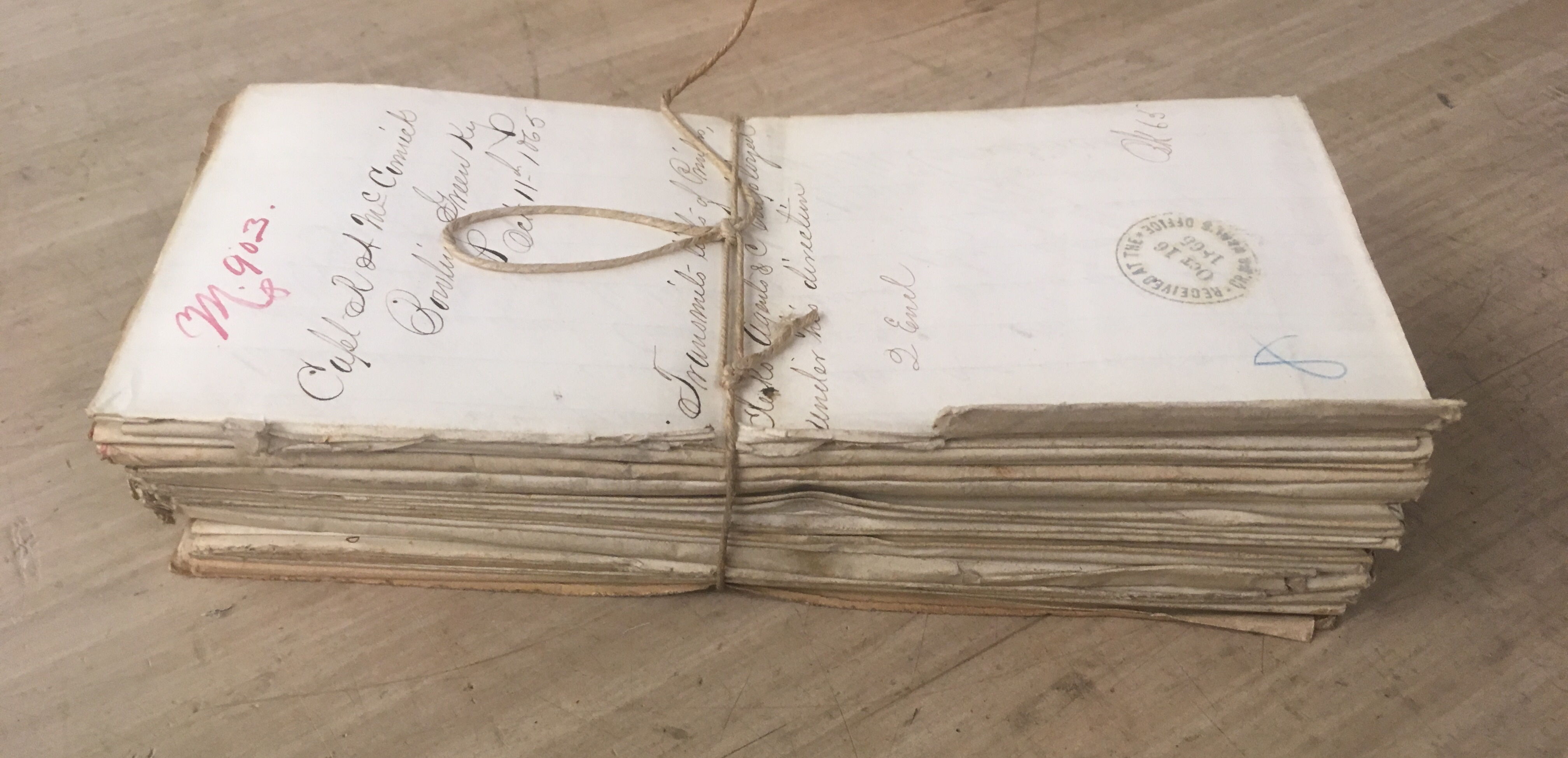
This small series is fully digitized. Each individual file unit is now is described in the National Archives Catalog by the name of the commanding officer and his geographic location, which vastly improves discoverability by researchers: see the screen shot below, which shows a few of the 389 file titles.

What records will you discover online in the National Archives Catalog?
On May 17, 2022, NARA’s 1950 Census website development team made a wonderful improvement to the name search feature. Names transcribed by humans are now shown in the search results above and below the census page image. What does this mean? Let’s look at an example.
Let’s search for Mildred Lauska in Ohio. Fortunately, some human transcribed her name.
Here’s the search result showing both OCR (optical character recognition) results AND human transcription results above the census page image in the upper right under “Matched Name(s).” (Click on the image for a bigger view.)’
Mildred Lauska, ED 92-47, with search result above the census page image

Here’s the same search result showing both OCR (optical character recognition) results AND human transcription results below the census page. (Click on the image for a bigger view.)
Mildred Lauska, ED 92-47, with search result below the census page image

Important Takeaways:
With all the excitement and preparation for the 1950 census over the past several months, you may have missed it: Millions of images of textual records keep being added to NARA’s online Catalog.
According to NARA’s “Record Group Explorer” webpage, as of March 2022 there are 161,492,780 scans online representing 1.393% of the approximate estimated total of 11.5 billion textual pages in the custody of the National Archives and Records Administration.
One month earlier, in February 2022, that number was 159,188,420 images: so in just one month, 2,304,360 images were added!
Back in August 2020, there were 111,114,108 images in the Catalog, so in 18 months, 50,378,672 images were added.
Fifty million, that’s a pretty big number. Considering that this growth happened during a pandemic that limited staff access to the buildings – and to the records – that’s pretty impressive.
The U.S. Census Bureau hosted a webinar on Monday, March 14, 2022, at 1 p.m., Eastern Daylight Time, to give the media and data users an overview of 1950 Census records set to be released from the National Archives and Records Administration (NARA) on April 1.
The webinar highlighted statistics from the 1950 Census, the historical context to how the 1950 Census was conducted, and provided information from the NARA on how to access these records when they become available to the public and what resources are available now. The presenters are:
Webinar video, slides, and other information
Resources: 1950 Census Records Release Press Kit
This post was updated 30 March 2022.
Premiering June 15, 2021, at 1 p.m. Eastern YouTube: The National Archives and Records Administration (NARA) recently accessioned the core collection of Merchant Marine Licensing Files, which are now open to the public for the first time at the National Archives at St. Louis. Theresa Fitzgerald, Director of the National Archives at St. Louis, will discuss these holdings as well as auxiliary collections of Merchant Marine records that are complex and closely connected. Presentation slides/handout here.

