NARA’s 1950 Census Genealogy Series Begins March 2, 2022

NARA’s 2022 Genealogy Series begins March 2, 2022, and it focuses on the 1950 census:

  • March 2: Overview of What’s on the 1950 Census
  • March 16: Mapping the 1950 Census: Census Enumeration District Maps at the National Archives
  • March 30: The 1950 Census Website: Design, Development, and Features to Expect
  • April 27: The Story of the 1950 Census Form P8, Indian Reservation Schedule
  • May 11: From Parchments to Printouts: History of the Census from 1790 to 1950
  • May 18: History of Census Records at the National Archives
  • May 25: Historic Census Bureau Sources for Filipino, Guamanian and Chamorro, American Samoan, and Native Hawaiian Research

You’ll definitely want to watch NARA staffer Michael Knight’s March 30 program on the 1950 Census website — which will allow — on Day 1 — name searches AND allow users to help NARA improve this “first draft” name index.

Additional lectures may be scheduled – so check back at https://www.archives.gov/calendar/genealogy-series/2022.

All lectures premiere at 1 p.m. Eastern time – and remain online afterwards on NARA’s Youtube Channel. See you at the program!

NARA 1950 Census Webpages Now Online

This week the National Archives launched several webpages devoted to the 1950 census, including the main page, 1950 Census Records, at https://www.archives.gov/research/census/1950. Information on these pages will undoubtedly evolve over time. The supporting informational pages include:

As noted on 1950 Census Records, you will be able to search the 1950 Census website by name and location beginning on Day 1 — April 1, 2022. To develop the initial name index, NARA used Amazon Web Services’ artificial intelligence / optical character recognition (AI/OCR) Textract tool to extract the handwritten names from the digitized 1950 Census population schedules. Because the initial name index is built on optical character recognition (OCR) technology, it will not be 100-percent accurate. The National Archives is asking for your help in submitting name updates to the index using a transcription tool that will be available on the 1950 Census website. You can help us improve the accuracy of the name index and make the records more accessible for everyone. More information on this volunteer opportunity will be forthcoming.

Researchers can learn more about this census from the 1950 Census blog posts at the History Hub and watch for news at National Archives News.

Tintypes and Photos in Civil War Pension Files

If you’ve ever wondered why some U.S. Civil War pension files have tintypes and photos – wonder no more! NARA archives specialist Jackie Budell details the reasons in three excellent recent blog posts at The Text Message:

(1) Civil War-Era Personal Tintypes Exposed: Your Questions Answered

(2) Civil War-Era Personal Tintypes Exposed: Why Private William Carman Sent a Tintype to His Wife

(3) Civil War-Era Personal Tintypes Exposed: Why William Carman’s Tintype Was in His Widow’s Pension File

Exciting 1950 Census News from NARA

When the 1950 Census becomes available on a NARA website on April 1, 2022, there will be a name search function powered by an Artificial Intelligence/Machine Learning (AI/ML) and Optical Character Recognition (OCR) technology tool. Granted, it will be imperfect on opening day – but that just means that all of us will have the opportunity to make it better through a transcription tool that will also be available. Exciting times! Read more about it at 1950 Census Release Will Offer Enhanced Digital Access, Public Collaboration Opportunity, a December 14, 2021 press release.

A Horse, of Course!

From colonial times to the early 20th century horses were the primary means of transporting the mail, whether by a single rider on horseback or by wagon or stage coach pulled by a team. Certainly mail was also transported by railroad as as the network of “iron horses” developed, as well as by river- and ocean-going vessels.

The image below is a detail from a poor quality photo postcard from circa 1916. There are two men on horseback. The man on the right is identified as W. H. Bennett of McKee, Kentucky, whose age (in 1959) was 87 years. His horse has two mailbags, one on each side to distribute the burden. The other man is not identified. There are trees and other vegetation behind them but no buildings are visible.

Mail carrier on horseback about 1916. W. H. Bennett, McKee, Kentucky, age 87 in 1959, and an unidentified man from [76] Transportation of Mail – Saddle Bags” (NAID 204376381).

This postcard was privately printed. It is in the U.S. National Archives by an accident of history. On 11 August 1959, Postmaster D. N. Thomas of McKeesville forwarded the postcard along with two leather saddlebags to the Post Office in Cincinnati, Ohio, as “Items for a Postal Museum.” The mailbags were “not desired” and thus were “left in Cincinnati.” The postcard, however, ended up in a collection of “Exhibit Materials Relating to Postal History, 1905-1958” (National Archives Identifier 17027514) assembled by the Post Office Department Library that was subsequently accessioned into the National Archives.

1810 Census for Salem, Essex County, Massachusetts

In 1810, Salem, Massachusetts, was the 9th largest city in the United States, with 12,613 people. New York City was first with 96,373, and nearby Boston was fourth with 33,787.

From 1790 to 1870, U.S. Marshals and their assistants conducted the census. Preliminary Inventory 161, Records of the Bureau of the Census, on page 94, states:  “Under the provisions of the decennial census acts, 1790-1820, the population schedules were to be deposited with the district court clerks, ‘who were to receive and carefully preserve the same.’ …  A resolution of May 28, 1830 (4 Stat. 430), directed the clerks of the district courts to forward the population schedules for the first four censuses to the Secretary of State.  …  It is known that the 1790 schedules for Rhode Island were forwarded to Washington on June 22, 1830, as a result of the May 28 resolution. Presumably other extant population schedules, 1790-1820, were forwarded at about the same time, but no documentation of such action has been found.”

The Bureau of the Census bound the extant 1810 census schedules into volumes sometime between 1902 and 1934, but the volume that included Essex County lacked the town of Salem. Decades later these same records were microfilmed as National Archives Microfilm Publication M252, Third Census of the United States, 1810, which can be found digitally on popular genealogy websites. It’s likely that many people looking through the 1810 census schedules for Essex County have wondered why Salem was omitted. The answer finally came to light this year.

For unknown reasons, the 1810 census schedules for Salem, Essex County, Massachusetts, became aliened (separated) from Federal custody. Somehow, they eventually came into the custody of the Peabody Essex Museum Library in Salem, Massachusetts. A National Archives staff member noticed a reference to these records on Instagram in February 2021, which set NARA’s Permanent Records Capture team on a mission to return these important records to federal custody. Read more about it here: “Instagram Post Leads to Recovery of 1810 Census Rolls.”

Digital images of the 1810 census for Salem can be viewed in the National Archives Catalog at https://catalog.archives.gov/id/205601220.

NARA 2021 Genealogy Series

National Archives Hosts Genealogy Series in May & June 
Participate in our genealogy series – free and online!
 

WHAT:  WASHINGTON, April 19, 2021–In lieu of the autumn 2020 Virtual Genealogy Fair that could not be held due to the COVID-19 pandemic, we are pleased to offer a new Genealogy Series! Instead of a single-day event, the program sessions will be broadcast individually during May and June. You are invited to watch and participate in real time with the presenters and family historians from around the world on YouTube

Over the two months, the sessions will offer family history research tools on federal records for all skill levels. The May sessions are broad and will appeal to the beginner and beyond. The June sessions are focused on specific topics and may be better suited for the experienced researcher. All are welcome! Session descriptions, videos, handouts, and participation instructions are available at the Genealogy Series web page.  

WHEN: May & June—all sessions begin at 1 p.m. ET

May 4 Preserving and Digitizing Personal Photo Albums and Scrapbooks

May 12 Finding Genealogy Resources and Tools on Archives.gov

May 19 Tips and Tools for Engaging Family with Your Research Finds

June 1  From Here to There: Researching Office of Indian Affairs Employees

June 8  Civil War Union Noncombatant Personnel: Teamsters, Laundresses, Nurses, Sutlers, and More

June 15  Merchant Marine Records at the National Archives at St. Louis 


WHO: Staff experts in government records from National Archives facilities nationwide.

WHERE: Anywhere! The series will be broadcast on the U.S. National Archives YouTube channel
 

HOW: Visit the Genealogy Series web page to watch the broadcasts on YouTube. Participants can watch individual sessions, download materials, ask questions, and interact with presenters and other family historians. No need to register—just click the links on the schedule to view the sessions!  Videos and handouts will remain available after the event.  

Captioning:  Live captioning will be available online with StreamText. If you require an alternative or additional accommodation for the event, please email KYR@nara.gov.

Background: The National Archives holds the permanently valuable records of the federal government. These include records of interest to genealogists, such as pension files, ship passenger lists, census, and Freedmen’s Bureau materials. See “Resources for Genealogists” online.

Follow the National Archives on Twitter @USNatArchives and join the Genealogy Series conversation using #GenieSeries2021.

Confederate Slave Payrolls

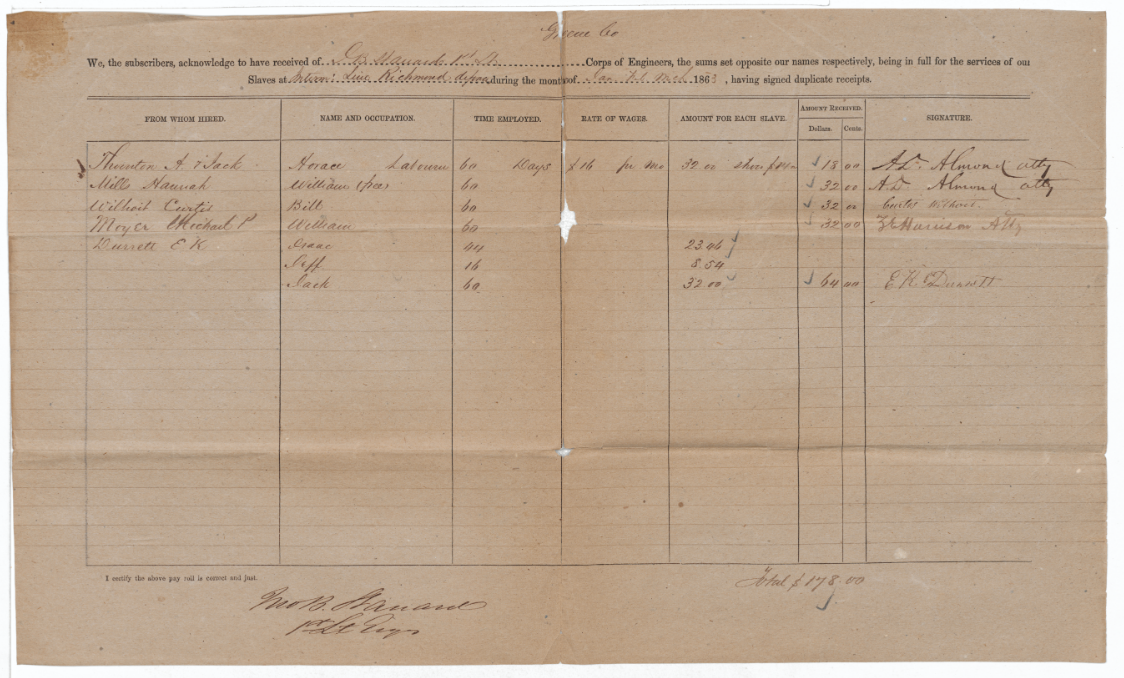
Today’s Washington Post has an informative article by Michael E. Ruane, “During the Civil War, the enslaved were given an especially odious job. The pay went to their owners.”  This article discusses the Confederate Slave Payrolls in the National Archives, which have all been digitized and are available online. These records show:

  • Names (first names) of slaves.
  • Name of the person from whom the enslaved person was hired (not necessarily their own slave owner).
  • Location at which employed.
  • Name of Confederate officer under whom the slave was employed.
  • When employed (month and year, and number of days).
  • Rate of pay and total pay.
  • Signature (or mark) of the owner or the owner’s agent (designated “Atty” due to their power of attorney) to acknowledge receipt of pay.
  • Some payrolls include the power of attorney given by a slave owner to authorize another person to collect payment on their behalf. The owner would execute a power of attorney if he or she was unable to go personally to the Confederate officer.
  • There are also records of free blacks who were impressed (forced to serve) and a few payroll records for white Quartermaster Department employees.

More information about these important records is given in my 2019 article, “Civil War Confederate Slave Payroll Records” as well as in the Confederate Slave Payrolls Scope and Content Note.

Screen Shot 2020-07-09 at 10.15.10 AM.png

Image: Side 2 of Slave Payroll 519 that shows six slaves and one free black man hired out of Greene County, Virginia, during January-March 1863, to work on the intermediate line of the defenses of Richmond, Virginia, under the command of 1st Lieutenant John B. Stanard.

Yet More Unusual Records…. and How to Find Them

If you were intrigued by the horse sales records mentioned in a recent post, there are plenty more records in the U.S. National Archives that are unusual, unexpected, or unknown to most persons, that are just waiting for researchers to examine and make good use of.

I’ve outlined search strategies in an article entitled, “The National Archives Catalog” which I hope you’ll try for yourself. Hint: URLs in “green” colored text in the article are clickable links!