Sharp Dressed Men of the 1880s – and a Few Women, Too

I recently wrote about District of Columbia police mug shots of criminals (primarily from 1883-1890) held by the National Archives in “Mug Books: An Unusual Avenue of Genealogical Inquiry” on “The Unwritten Record” blog of the National Archives. As one commenter noted there – “they are all dressed well…” – hence the title for this post.

Most of the mug shots were created by the DC police, but there are others collected from the police departments of New York City and Philadelphia. One of the most striking things about this series is that over 100 of the 717 cards in this series are for persons were arrested on March 4-6 of 1885 or 1889. This was not a coincidence. The presidential inaugurations of Presidents Grover Cleveland and Benjamin Harrison occurred on March 4, 1885, and March 4, 1889, respectively. One can imagine professional pickpockets and other con men going to Washington, DC, to ply their trade in the well-off crowd visiting the capital for the big event. This was most likely true of famous professional criminal Charles Hallert, alias “Red Hyle” or “Cincinnati Red,” and his friend Charley Williams, alias Shane Campbell, who were both arrested on March 6, 1885. Red Hyle, “one of the most celebrated hotel thieves in this country” is profiled by NYC Chief of Detectives Thomas Byrnes in Professional Criminals of America (New York: Cassell & Company, Ltd.), at pages 109-110.

The significant “inaugural connection” of this series is not immediately obvious at a casual glance. It is an example of an archival truth – it can take deep immersion in a body of records to truly understand them. In this case, while laboriously tagging each photo in the National Archives Catalog, it eventually struck me that I was seeing “March 4” over and over again. I knew March 4 was inauguration day in the 19th century. Then I checked which years the “March 4” cards were from. With but one exception, they were from 1885 and 1889. Inauguration Day.

I hope that researchers will thoroughly study this series. There are undoubtedly many other interesting things that can be learned from it.
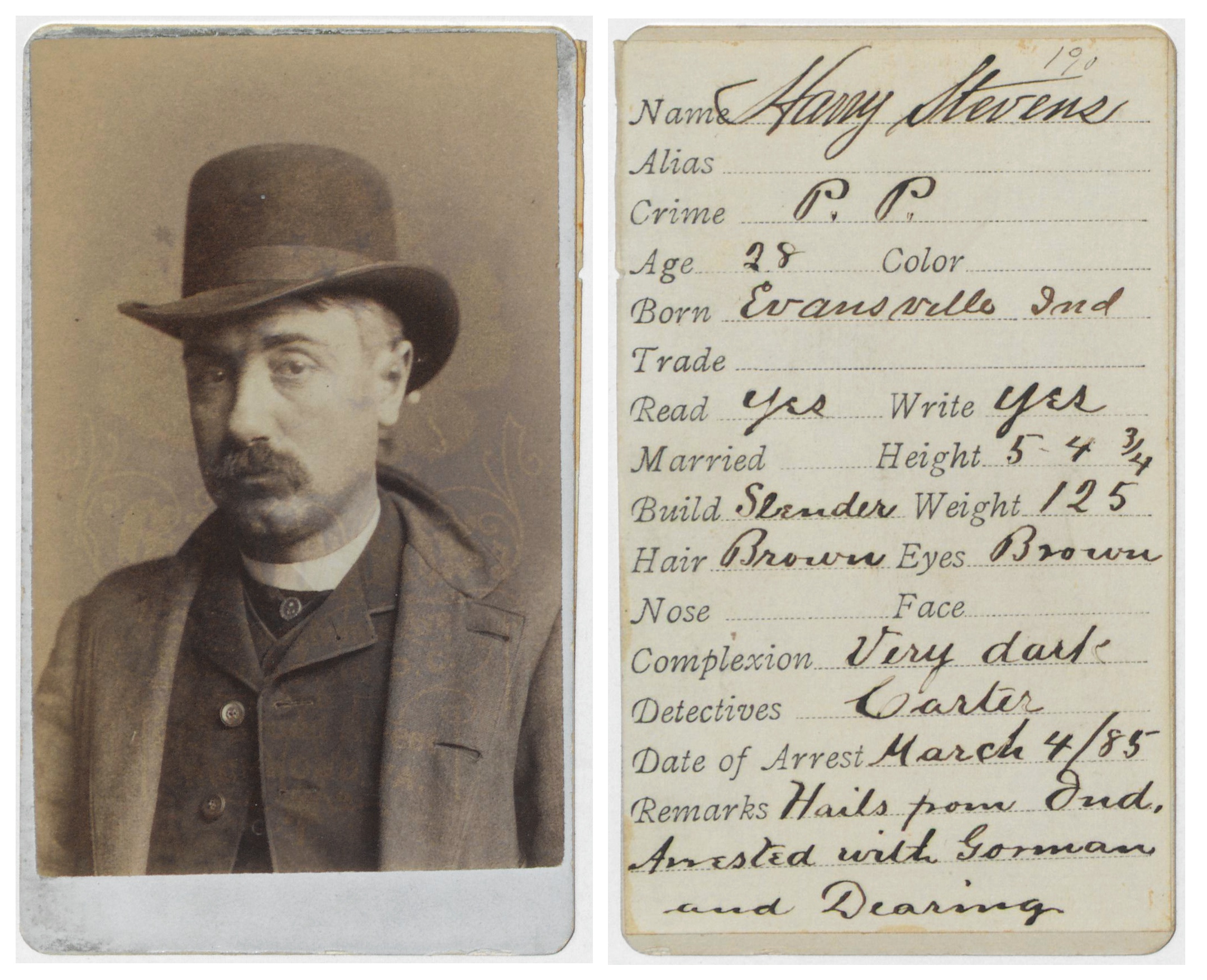
Identification Card No. 190, Harry Stevens (National Archives Identifier 75449274)

Counting Down to the Opening of the 1950 Census!

The “countdown clock” to the right shows you how many days remain until the digital opening of the 1950 census on 1 April 2022. It will be here faster than you think! Time to get ready!

Therefore, I’ve started writing about the 1950 census on the History Hub website with the first installment today: “1950 Census: How the Census Forms and Procedures Were Developed.”

Death and Burial Practices in World War I and World War II

You’ll want to see a great presentation by Rick Sayre, CG, CGL, FUGA, on Death and Burial Practices in World War I and World War II, a webinar on the Legacy Family Tree Webinars site. Rick walks you through the procedures used to identify, bury, and honor U.S. war dead, and the records created in that process. It’s free to all to view through 26 January 2021.

As the webinar description states: “Much of this webinar focuses on the process of collecting, identifying, and burying the dead, and the resulting records, including their genealogical significance. In World War I (1917–1918) there were 53,402 battle deaths, while in World War II (1941–1945) battle deaths rose to 291,557. There are 124,905 American war dead interred overseas. This webinar also addresses how the United States honors and memorializes those killed in battle, including the role of the American Battle Monuments Commission, the American Gold Star Mothers program, and the operation of the Army’s Grave Registration Service.”

The Ubiquitous Card File

The National Archives recently digitized the Card File of Population Data Relating to the 17th Census, 1950 (National Archives Identifier 2990400). While this card set is mundane and may not be extraordinarily useful, it serves as a good reminder that BCE – “before the computer era” – people, businesses, and government alike used “card files” as a data management tools for quick storage and retrieval of important, useful, or frequently accessed information as discussed in my recent blog post, Census Fun Fact #5 – The Geography Division’s Quick Reference Card File of 1950 Census Population Data. Check it out.

P.S.: The 1950 population census will become available to researchers on April 1, 2022.

Census Fun Fact #4 – The Nonresident Schedule of the 1940 Census

Census Fun Fact #4 – The Nonresident Schedule of the 1940 Census is the fourth installment of my “Census Fun Facts” series on the “History Hub” website. This post takes a quick look at how people away from home were enumerated – and how evidence of one Wisconsin couple’s trip to Florida in the winter/spring of 1940 came to be preserved in the 1940 census.

Census Fun Fact #3 – Do You Own a Radio Set?

Census Fun Fact #3 – Do You Own a Radio Set? is the third installment of my “Census Fun Facts” series on the “History Hub” website. As the “internet” and “social media” of its time, statistics on the rise and extent of radio ownership were important to leaders in government, business, education, and other fields. The 1930 census was the first census to feature a question about technology in the home.

Census Fun Fact #2 – Fictional Names: Just Call Me Another Time

Census Fun Fact #2 – Fictional Names: Just Call Me Another Time is the second installment of my “Census Fun Facts” series on the “History Hub” website. It features some folks with interesting names who are “hiding in plain sight” in New Orleans, Louisiana, on the 1910 census.